
Data Enrichment
|2026-03-12
Your Guide to High-Accuracy Email Address Lookup
Finding a prospect's email is the starting point for every sales conversation. Learn how to move beyond manual guesswork to automated enrichment with 97%+ accuracy and real-time validation.
Finding a prospect's email address is more than just a task—it's the starting point for every meaningful sales conversation. For any B2B team, getting this right is the first, most critical step in building a pipeline, personalizing outreach, and ultimately, driving revenue. An effective email address lookup process finds a specific person's professional email, often starting with just their name and the company they work for.
Why Data Accuracy Is Everything in Modern Sales

In B2B sales, your contact data quality directly determines how much revenue you can generate. An email lookup isn't about finding just any email. It's about finding the right one. When sales development teams work with bad data, the problems snowball, creating hidden costs that go way beyond a few bounced messages.
The most obvious hit is to productivity. Every single minute a sales rep spends crafting a thoughtful, personalized email for an address that bounces is a minute they could have spent engaging a real, qualified buyer. That wasted time adds up fast across a team. What should be a high-impact activity quickly turns into a frustrating, dead-end exercise.
The Hidden Costs of Inaccurate Emails
But lost time is just the beginning. Bad data actively hurts your sender reputation. Email providers like Google and Microsoft are always watching. High bounce rates from your campaigns send a clear signal that you're a low-quality sender, which can get your emails flagged as spam or blocked entirely.
This reputational damage is hard to reverse. Once you're flagged, even your best emails to valid prospects might land in the spam folder, making your entire outbound strategy ineffective. With recent policy changes, senders of over 5,000 emails per day face even stricter rules, making deliverability a bigger challenge than ever before.
The final cost of bad data is the most painful: lost revenue. Every email that fails is a lost chance to start a conversation, book a demo, and close a deal. The old days of manually guessing email patterns like first.last@company.com are long gone. Modern security and complex corporate structures make that approach a shot in the dark.
Inaccurate contact data is the silent killer of sales productivity. It doesn't just cause bounces; it tanks your sender reputation, wastes countless SDR hours, and directly translates to lost revenue.
Let's look at what this means in practice. The table below shows the real-world impact of data accuracy on a typical outbound campaign's ROI.
Impact of Email Data Accuracy on Campaign ROI
| Metric | Low-Accuracy Data (<75%) | High-Accuracy Data (97%+) |
|---|---|---|
| Email Deliverability | < 75% | > 97% |
| Bounce Rate | > 25% (High risk of account suspension) | < 3% (Healthy) |
| SDR Wasted Time | ~25% of outreach time on bad leads | < 3% of outreach time on bad leads |
| Meetings Booked | Significantly lower; missed opportunities | Maximized; reps engage more prospects |
| Sender Reputation | Damaged, future emails flagged as spam | Protected, ensuring inbox placement |
| Campaign ROI | Negative or break-even at best | Significantly positive |
As you can see, the difference isn't just incremental—it's the difference between a failing campaign and a highly profitable one.
The Power of High-Fidelity Data
This is exactly why top RevOps leaders have stopped accepting "good enough" data. They're demanding precision, and for good reason. The ROI is undeniable: email marketing can generate $36 to $42 for every dollar spent, and nearly 80% of business leaders say personalized experiences drive more customer spending.
Getting to that level of accuracy takes more than a simple database lookup. That's where advanced platforms like RevoScale come in. Instead of just checking one source, they run a process called AI waterfall enrichment. This means they query over 50 data providers in real time, compare the results, and then instantly validate the best option to confirm it's deliverable.
This turns a basic email lookup from a chore into a real strategic advantage. Your team gets a list with a 97%+ accuracy rate, not a spreadsheet full of question marks. By getting the data right from the start, you free your reps to do what they're best at: building relationships and closing deals.
Core Methods for Finding Professional Emails
When it comes to finding email addresses, not all approaches are created equal. Your strategy depends on your goal. Are you zeroing in on a single high-value executive, or are you trying to build a massive list for a new campaign?
Think about the day-to-day reality for a sales development rep (SDR). They've just identified the perfect decision-maker—let's say a VP of Marketing at a key target account. They don't need a list of a thousand people; they need one accurate email, and they need it now. This is the world of the single lookup, where speed and precision are everything.
Now, picture a RevOps leader staring at a spreadsheet with 10,000 leads from a recent trade show. Their priority isn't one-off searches. They need to enrich that entire list with verified contact data at scale. This is bulk lookup, a process built for volume and efficiency, designed to fuel entire marketing and sales campaigns.
From Manual Guesswork to Automated Enrichment
Years ago, finding emails involved a lot of educated guessing and bouncing messages. Top-performing B2B teams have moved on to more reliable, tech-driven methods.
Here's how modern teams get it done:
- Single Email Lookup: This is your bread and butter for targeted prospecting. You have a name and a company ("Jane Doe" at "Acme Corp"), and you use a tool—often a browser extension or web app—to instantly find their verified email. It's perfect for account-based sales where you're building relationships with specific people.
- Bulk Email Enrichment: This is the engine for scaling your outbound efforts. You start with a CSV file of prospects (maybe just names and company domains) and upload it. The platform then works its magic, appending verified email addresses to each contact on your list. Marketing teams enrich lists of 2,000 webinar registrants this way in just a few minutes.
- Reverse Email Lookup: What about when a lead comes to you? Sometimes, all you have is an email address, like
j.doe@acme.com. A reverse lookup takes that single piece of information and builds out a full profile, giving you their name, job title, LinkedIn profile, and company details. It's incredibly useful for qualifying inbound leads and personalizing your first touchpoint.
The right tool completely depends on your workflow. An SDR chasing five key accounts a day lives inside a single-lookup tool. A marketing ops manager prepping a 20,000-contact campaign needs a powerful bulk processor. A truly great platform has to master both.
Integrating Lookups Directly into Your Workflow
The most efficient way to handle contact data is to automate it entirely with an email address lookup API. This allows you to build email enrichment directly into the tools you already use, cutting out the manual work and ensuring your data is always fresh.
Imagine a new lead submits a form on your website. Instead of that lead sitting in your CRM as just a name and an email, an API call can happen in the background, in real time.
By the time the lead record is created in Salesforce or HubSpot, it's already enriched with a verified email, current job title, company size, and industry. Your sales team can then follow up instantly with a message that's relevant and personalized because they have all the context they need from the very first second.
This isn't a luxury anymore; it's how high-velocity teams stay ahead. A platform like RevoScale, with its unlimited email finder, brings all these methods under one roof. Whether you need a quick search from a Chrome extension, a bulk file enrichment for 250,000 records, or a full REST API integration, you have one tool that does it all. This stops you from juggling—and paying for—separate tools for finding, verifying, and enriching your contacts.
Found an Email? Why Validation Is Your Most Critical Next Step

So you've found a list of promising email addresses. The job's done, right? Not even close. Finding the email is just the first step—what you do next is what separates a successful campaign from a one-way ticket to the spam folder.
Without validating those emails in real time, you're flying blind. You're sending messages into the void, hoping they land, all while putting your domain's reputation on the line. Every bounce sends a signal to email providers that you're a source of spam, and it doesn't take long for even your legitimate emails to stop getting through.
Many basic lookup tools are decent at pattern matching. They can guess that "John Doe" at "Acme Inc." is probably john.doe@acmeinc.com. But that's all it is—a guess. They leave you with a list of maybes, and "maybe" isn't good enough when your pipeline is on the line.
What Real Validation Actually Checks
A proper validation process goes way beyond just checking for typos. It's a series of quick but sophisticated checks to confirm an email is real, active, and safe to contact.
- Syntax Check: First, it confirms the address format is correct (
name@domain.com) and doesn't contain illegal characters. It's a simple, but necessary first pass. - The SMTP Handshake: This is the real test. The validation service pings the recipient's mail server to ask if the specific inbox actually exists and can receive mail. Think of it as knocking on the door to see if anyone's home without actually having to go inside.
- Catch-All Domain Detection: Some companies set up their servers to accept any email sent to their domain, which means you never know if you're reaching a real person. Good validation tools spot these risky catch-all servers, helping you avoid them and protect your sender score.
The market for this is incredibly competitive, and accuracy is everything. Public data shows a massive gap in performance. For example, some tools can hit over 81.0% accuracy, while others like Hunter.io might only deliver 39.8% valid emails on the same search. Any tool that can't consistently break a 75% accuracy threshold is a liability for any serious B2B team.
An unverified email is a guess. A verified email is an asset. One wastes time and ruins your sender reputation; the other fuels your pipeline.
This is where you see the huge advantage of an integrated platform. Instead of finding an email with one tool and then paying a separate service to verify it, a modern solution does both in a single step.
Take RevoScale, for instance. Its AI waterfall enrichment doesn't just find one potential email; it queries over 50 data providers to find the best possible contact information. More importantly, it validates that email in real-time as part of the process.
The end result is a verified contact with a 97%+ accuracy guarantee, all delivered in under two seconds. This means when your team hits "send," they can be confident the message is actually going to land in a real person's inbox. If you want to dive deeper into the technical side, our guide on how to validate emails breaks it down even further.
Weaving Email Lookup Into Your Sales Tech Stack
An email lookup tool is great, but its real value comes from how well it plugs into your team's existing workflow. For any RevOps leader or sales manager, the objective is to get past the one-off, manual searches. The goal is a smooth, automated flow of accurate data right into the systems your team lives in every day. When enrichment happens automatically in the background, without a single SDR having to open another browser tab, you've hit operational gold.
Truly effective integrations embed this data enrichment at critical moments. We're talking about enriching a new lead the second it hits your CRM, running a full-scale data cleanse to fight off data decay, or even building custom pipelines that fit your unique business model. This is how you ensure every contact record is always fresh, accurate, and ready for action.
Automate Your Inbound Lead Enrichment
Think about your typical "Request a Demo" form. A prospect fills it out, and a new lead appears in your CRM with just a name and an email. What happens next? Your sales rep has to drop everything and spend precious time on LinkedIn, trying to piece together the prospect's job title, company details, and a reason to reach out.
An integrated enrichment platform completely flips that script. The entire process becomes automated.
- Real-Time API Call: The moment that form is submitted, a webhook instantly triggers an API call to your enrichment tool.
- Instant Data Enrichment: The platform gets to work, finding and verifying the prospect's professional email, mobile number, current title, company size, industry, and more.
- A Fully Actionable Record: Seconds later, the lead record in your Salesforce or HubSpot CRM is complete. Your SDR gets a notification with a rich, actionable profile, empowering them to personalize their first touchpoint immediately.
This automated flow turns your inbound process from reactive to proactive. You're not just saving time; you're shrinking the time-to-contact for every lead and giving your conversion rates a serious boost.
A REST API is the bridge between raw lead data and a fully qualified prospect. Integrating it with your web forms means your sales team gets a complete, verified profile the second a lead shows interest, eliminating manual research and accelerating your speed-to-lead.
Keep Your CRM Data Healthy at Scale
Your CRM is supposed to be your team's single source of truth, but that truth has a shelf life. People get promoted, switch jobs, or leave companies altogether. It's a well-known problem: B2B contact data decays at a staggering rate of over 30% per year. This means a huge chunk of your database becomes useless every few months.
Trying to run campaigns with a decaying list doesn't just waste money—it actively damages your sender reputation. This is where bulk enrichment integrations come in.
Here's a common workflow for a CRM data refresh:
- A RevOps manager exports a segment from the CRM—say, all contacts who haven't been engaged in the last six months.
- That CSV file, often containing thousands of records, is uploaded to a platform like RevoScale for bulk processing. The system re-verifies every email and finds fresh, current contact info for anyone who has moved on.
- The newly enriched and validated data is then imported back into the CRM, overwriting the old, stale records.
This kind of proactive data hygiene ensures your campaigns always hit a fresh, accurate audience, which maximizes both deliverability and engagement. RevoScale's platform was built for this, handling up to 250,000 records in a single go. And if you want to make automation even simpler, you can explore dozens of native and Zapier-powered RevoScale integrations to connect your favorite tools.
Build Custom Data Pipelines for Advanced Needs
For more sophisticated operations, a flexible REST API is non-negotiable. It gives you the power to build completely custom email lookup and enrichment workflows that are tailored to your specific GTM strategy.
Agencies managing multiple clients or large enterprises with complex internal systems depend on APIs to create these efficient, automated data pipelines. It's what turns a simple lookup tool into a foundational piece of your revenue infrastructure, ensuring accurate data is always right where you need it, when you need it.
Choosing the Right Email Lookup Tool
Picking the right email lookup tool isn't just about ticking boxes on a feature list. It's a strategic call that directly impacts your sales team's speed, your budget, and your ability to actually grow. Many platforms look great on the surface, but your evaluation needs to cut through the noise and focus on what drives results.
While you're looking at things like accuracy and bulk processing speed, there's one factor that most teams overlook until it's too late: the pricing model. Understanding the fundamental difference between a restrictive, credit-based system and a predictable flat-rate plan can be the single most important decision you make.
Accuracy Guarantees and Data Sourcing
Before you even think about price, your first question should always be about data quality. A tool that serves up bad emails is worse than no tool at all. Don't fall for vague marketing claims of "high accuracy." You need to see a real number.
Look for a platform that's confident enough to offer a public accuracy guarantee, ideally 97% or higher. This isn't a magic number; it's the result of sophisticated tech like AI waterfall enrichment, where the system checks dozens of sources in real time to find and validate the best possible email. A provider who trusts their process will be upfront about their accuracy.
Speed and Bulk Processing Capabilities
Let's be honest, sales is a game of speed. Your team can't afford to be stuck waiting minutes for a single contact or hours for a list to enrich. Look for a tool that returns results in seconds. A sub-two-second enrichment speed, for instance, means your SDRs can operate without any frustrating delays.
Just as important is how the platform performs under pressure. As you scale, so will your data needs. Can the tool chew through a file with 10,000, 50,000, or even 250,000 contacts without choking? A powerful bulk processing engine is non-negotiable for big projects like cleaning your CRM or prepping for a massive outbound campaign. You'll hit a wall fast without it.
The Critical Difference in Pricing Models
This is where everything comes together. The vast majority of B2B data tools, including big names like Hunter.io and Lusha, run on a credit-based model. It might seem like a good deal initially, but this structure is designed to create friction and unpredictable costs that actively slow you down.
Think about it. With credits, every single search, verification, or export eats into a monthly allowance. Your reps start to second-guess themselves, rationing lookups because they're afraid of "wasting" a credit on a prospect who isn't a perfect 10/10. This creates a scarcity mindset that kills the very activity you need to fill your pipeline. And when you inevitably burn through your credits mid-month? You're stuck paying outrageous overage fees or telling your team to stop prospecting.
Credit-based pricing forces your sales team to ask, "Is this prospect worth the cost?" every single time they do a lookup. That hesitation is the enemy of high-velocity sales. It kills momentum and ends up punishing your most active reps.
A flat-rate, unlimited model throws that friction out the window. When a team uses a platform like RevoScale, they pay one fixed price for unlimited everything. Reps can search, enrich, and export as much as they need to without ever thinking about cost. This freedom empowers them to build bigger lists, take more shots, and ultimately, book more meetings. It's a game-changer for agencies, too—no more juggling different credit pools for different clients.
The table below breaks down exactly how these two models stack up in the real world.
Comparing Pricing Models: Credit-Based vs. Flat-Rate Unlimited
| Evaluation Criteria | Credit-Based Models (e.g., Hunter.io, Lusha) | Flat-Rate Unlimited Model (RevoScale) |
|---|---|---|
| Budget Predictability | Low. Costs fluctuate with usage and overages. | High. Fixed monthly cost regardless of usage. |
| Team Scalability | Poor. Adding reps or campaigns requires buying more credits. | Excellent. Scale your team's activity without cost increases. |
| SDR Productivity | Hindered. Reps hesitate to use credits, slowing activity. | Maximized. Reps can prospect freely without limitations. |
| Data Enrichment | Discouraged. Bulk enrichment is expensive and drains credits fast. | Encouraged. Enrich entire databases at no extra cost. |
| Return on Investment | Capped. ROI is limited by how many credits you can afford. | Uncapped. Drive maximum pipeline without data constraints. |
In the end, it all comes down to what you're trying to build. If your goal is to create a high-velocity sales engine that can scale without surprise costs, an unlimited email finder is the only choice that makes sense. It tears down the artificial walls that credit limits build and frees your team to do what they do best: sell.
Building a Modern B2B Prospecting Workflow
So, how does all this theory translate into a real-world prospecting machine? It's about creating a repeatable system where high-quality data fuels everything you do, from identifying the right accounts to sending personalized outreach that actually gets a response. The entire engine runs on the accuracy of your initial email address lookup.
Everything starts with a rock-solid Ideal Customer Profile (ICP). Go beyond the basics and get granular. Think firmographics like company size and industry, but also technographics—what software are they already using? Once you have that crystal-clear picture, you can build a target account list (TAL) of companies that are a perfect match.
From List Building to Enriched Data
With your target accounts identified, the real work begins. This is where you turn a simple list of company names into a rich database of contacts you can actually talk to. This is where bulk enrichment comes in.
Imagine your sales team is going after VPs of Marketing at Series B SaaS companies. Instead of hunting for contacts one by one, they can:
- Upload their entire list of target companies to a platform like RevoScale.
- Filter for the exact job titles they need within those specific accounts.
- Run the enrichment to get a full list of verified contacts, complete with emails and phone numbers.
A good enrichment process doesn't just stop at emails. It should pull in direct-dial mobile numbers, LinkedIn profiles, and extra company details. This enriched list is the foundation for every single piece of outreach that follows.
An effective prospecting workflow isn't about finding one email at a time. It's about systematically enriching your entire target market with verified, multi-channel contact data so your sales team can focus on conversations, not research.
Choosing the right tool is critical here. Your pricing model—whether it's based on credits or an unlimited plan—will directly impact how aggressively you can build and enrich your lists.
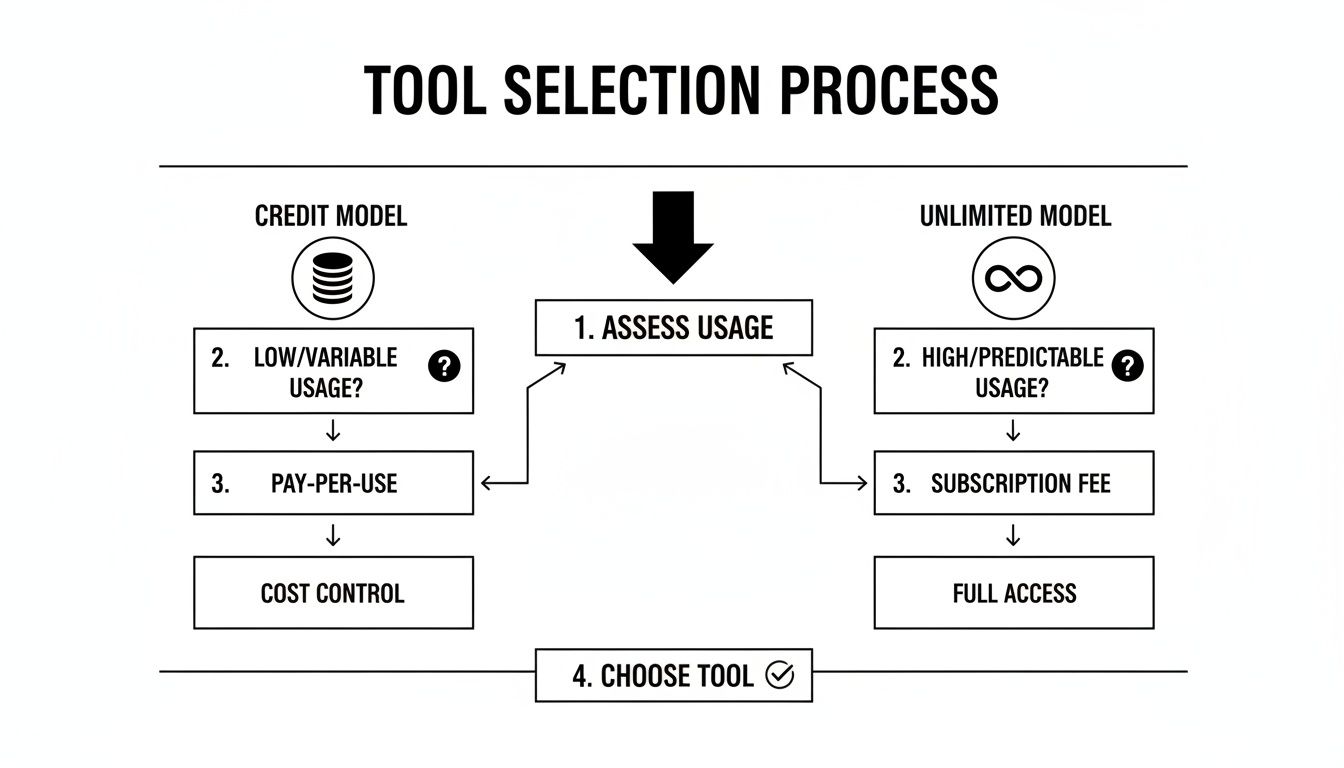
The takeaway is simple: credit-based tools make you hesitate, forcing you to ration your lookups. An unlimited model removes that friction and lets you enrich data at the scale modern prospecting demands.
Launching Personalized, Multi-Channel Sequences
Now for the fun part: turning that enriched list into conversations. Forget generic email blasts. The key is to segment your contacts into smaller, highly relevant groups based on things like their industry, company size, or specific challenges you know they face.
With these segments, you can launch personalized outbound sequences. Email is still king in B2B—93% of users check their inbox daily, and the average office worker gets swamped with over 80 emails per day. To have any chance of standing out, your message has to be razor-sharp.
A truly modern workflow layers multiple touchpoints together. It might look something like this:
- Day 1: A personalized email referencing a specific company trigger, like a recent funding round or a new executive hire.
- Day 3: A connection request on LinkedIn with a short, contextual note.
- Day 5: A quick call using the direct-dial number you sourced during enrichment.
From defining your ICP all the way to multi-channel outreach, every step is powered by that initial data enrichment. When you have a tool like RevoScale giving you unlimited, 97%+ accurate data, you're giving your team the fuel needed to run this engine at full throttle and turn cold lists into a healthy pipeline.
Clearing Up Common Questions About Email Lookups
When you're trying to scale your outreach, a few key questions always come up. Getting the right answers from the start can save you a ton of headaches, so let's tackle the most common ones I hear from sales and revops teams.
Just How Accurate Are Email Lookup Tools, Really?
Honestly, the accuracy is all over the map. I've seen platforms that barely clear 40%, while others can get you over 80%. The real game-changers, though, are the advanced tools like RevoScale that now hit 97%+ accuracy.
They achieve this with what's called an AI waterfall enrichment process. Instead of just pulling from one dusty database, this method intelligently queries multiple data providers and then performs a real-time validation check on every single email it finds.
For any serious B2B prospecting, you need a tool that's transparent about its accuracy. If they can't guarantee at least 90%, you're risking your sender reputation and burning through your team's time on bounced emails.
Is It Legal to Look Up Emails for B2B Outreach?
This is a big one, and the short answer is yes—for B2B commercial outreach, it's generally compliant with U.S. laws like CAN-SPAM. You just have to follow the rules: include a clear way for people to opt out, don't write misleading subject lines, and make it obvious your message is an advertisement.
The major caveat here is geography. Regulations like GDPR in Europe are much stricter. Always make sure your data sourcing and outreach tactics are fully compliant with the laws in the specific regions you're targeting.
What's the Difference Between an Email Finder and an Email Verifier?
Think of it this way:
- An email finder is the detective. It takes a name and a company and hunts down the likely email address. It's the discovery part of your workflow.
- An email verifier is the gatekeeper. It takes an email you already have and confirms whether it's valid, active, and won't result in a hard bounce.
In the past, these were often two separate, clunky steps. But modern platforms like RevoScale have merged them. The system finds the most probable email and instantly verifies its deliverability, all in one go. This means you get a clean, actionable contact without juggling different tools or paying for separate verification credits.
When you're ready to move past guesswork and connect with confidence, RevoScale brings it all together. You get an all-in-one platform with an unlimited email finder, on-the-spot validation, and a 97%+ accuracy guarantee. Forget about the credit limits and surprise bills from tools like ZoomInfo or Apollo.io. RevoScale's flat-rate pricing (starting at just $49/month) gives your entire team the freedom to prospect without limits. Try RevoScale free today and see how a simple, flat-rate plan can fuel your entire sales engine.