
Lead Generation
|2026-02-27
The 12 Best AI Lead Generation Tools to Scale Pipeline in 2026
The traditional B2B lead generation playbook is broken. We analyze the 12 best AI-powered platforms to help you find the right tool for scalable, repeatable pipeline generation.
The traditional B2B lead generation playbook is broken. Buying static lists, spending hours on manual research, and sending generic email blasts simply doesn't produce the results it once did. It's an inefficient process built on outdated data, delivering a poor experience for buyers and frustrating returns for sales teams.
Modern revenue teams are moving away from this volume-first model. Instead, they are adopting an intelligent, data-driven approach powered by a new class of AI lead generation tools. These platforms are not just another gadget for your tech stack; they are fundamental to building a scalable and repeatable pipeline engine. By automating tedious prospecting tasks, enriching contact data in real time, and identifying prospects who are ready to buy, they allow teams to focus on what matters most: building relationships and closing deals.
This guide moves beyond surface-level marketing claims to give you a detailed breakdown of the 12 best AI-powered platforms available today. We'll analyze what each tool does, who it's built for, and its specific strengths and weaknesses. You will find practical insights to help you choose the right solution for your specific needs, whether you're an SDR, a RevOps leader, or a startup founder.
1. RevoScale
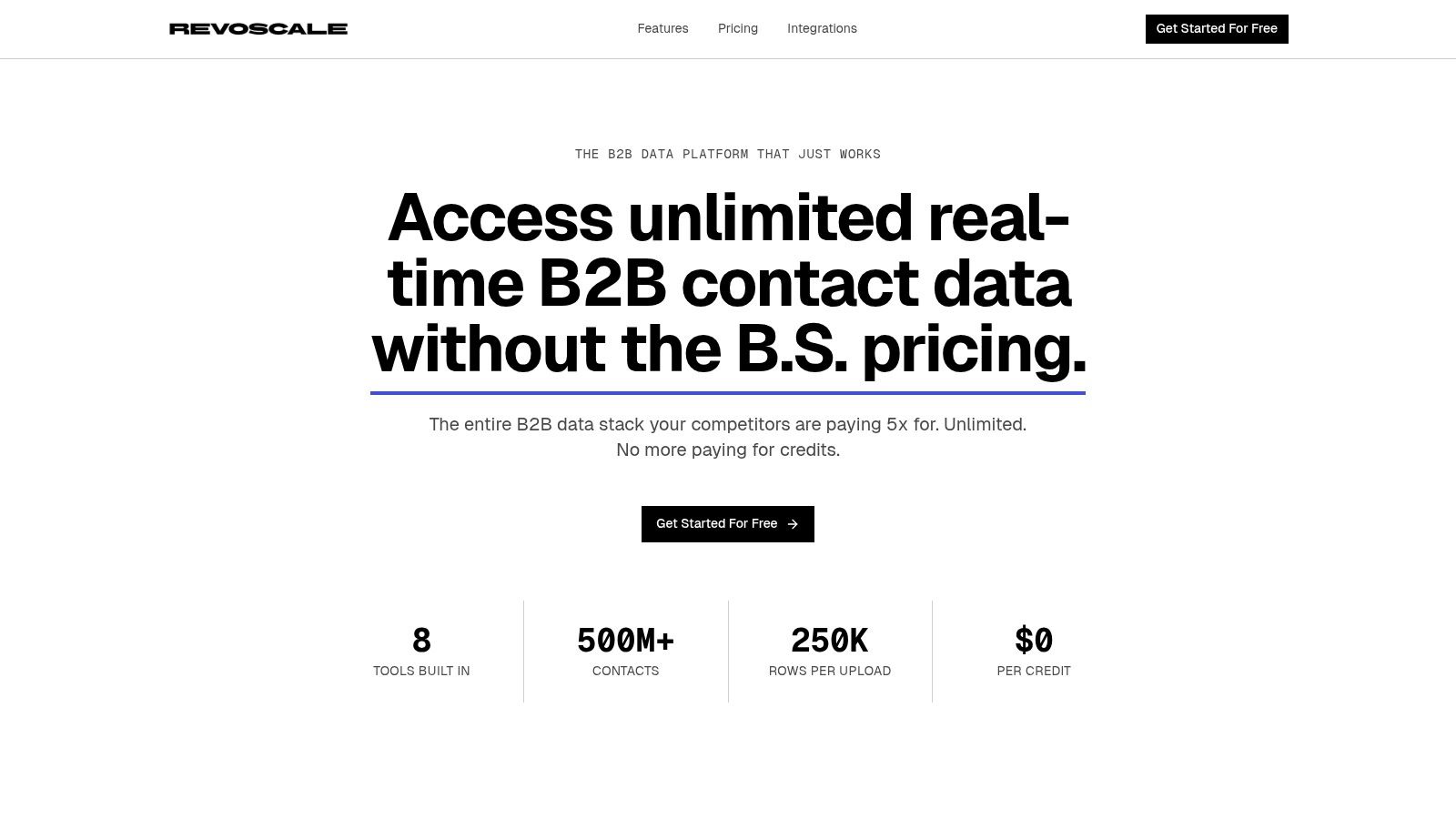
RevoScale earns its top position as a standout all-in-one platform engineered to consolidate the often-fragmented B2B prospecting stack. It directly addresses the core challenges faced by modern revenue teams: managing multiple credit-based data vendors, juggling disparate outreach tools, and manually executing repetitive pipeline-building tasks. By integrating data enrichment, verification, intent signals, and outbound automation into a single, cohesive system, RevoScale provides a unified foundation for building a scalable and repeatable lead generation process.
The platform is designed for efficiency at scale. Its core AI-powered enrichment engine queries over 50 data providers in a waterfall sequence, validating contact and company information in real time to deliver results with a reported 97%+ accuracy. This approach removes the guesswork and manual verification often required when using single-source data vendors. The result is a high-coverage, dependable data set that fuels effective outbound campaigns.
Key Features & Use Cases
RevoScale's feature set is notable for its breadth and accessibility across all plans. This makes it one of the most complete AI lead generation tools for teams aiming to reduce tool sprawl and operational costs.
- All-in-One Data Toolkit: Every subscription includes a full suite of tools: Email Finder & Verifier, Personal Email Finder, Mobile Phone Finder, B2B Lead Exporter, and even a Google Maps scraper. This eliminates the need to pay for separate services for finding, validating, and enriching leads.
- High-Volume Bulk Processing: Users can upload lists of up to 250,000 records at once and run up to five concurrent enrichment jobs. Higher-tier plans offer accelerated processing speeds (up to 4x), making it a strong fit for RevOps teams managing large-scale data hygiene projects or agencies processing client lists.
- AI-Powered Prospecting & Personalization: The platform includes an AI lead discovery feature that generates targeted lead lists from plain-English descriptions of your Ideal Customer Profile (ICP). Furthermore, its personalization engine can draft outreach messages based on recent company news, funding announcements, and other activity, helping SDRs improve relevance with less manual research.
- Unified Outreach Sequencing: Built-in sequencing allows teams to automate multi-channel outreach across email, LinkedIn, and phone calls. The visual, drag-and-drop workflow builder empowers non-technical users to construct complex end-to-end pipelines, from initial lead enrichment to CRM updates.
Pricing Structure
RevoScale's pricing is transparent and predictable, a significant departure from the credit-based models common in the data vendor space. All plans include API access and the full toolset, with tiers differentiated by volume and speed.
- Starter: $49/month
- Growth: $99/month
- Pro: $199/month
- Agency: $349/month
Our Take
| Pros | Cons |
|---|---|
| Complete Toolkit: The all-in-one approach replaces multiple vendor subscriptions, creating significant cost and operational savings. | Limited Public Case Studies: The website lacks a deep library of customer testimonials, which can make it harder for new buyers to gauge third-party social proof. |
| Predictable Flat-Rate Pricing: No per-email or per-credit charges. This simple monthly fee structure makes budgeting straightforward for startups and enterprises alike. | Potential Overkill for Small Teams: Very small teams with minimal lead generation needs might find the processing limits on higher tiers unnecessary for their actual usage volume. |
| High-Volume & Accurate Enrichment: The platform is built for bulk processing with fast, high-accuracy results, making it ideal for data-intensive operations. | |
| Enterprise-Ready: With SOC 2 Type II compliance, SSO, and RBAC, RevoScale meets the security and governance requirements of larger organizations. | |
| Practical AI Features: The AI for ICP-based lead discovery and message personalization offers genuine time savings and improves the quality of outbound prospecting. |
RevoScale is an exceptional choice for RevOps leaders, SDR teams, and agencies seeking to build an efficient, scalable, and cost-effective lead generation engine. Its unified platform, transparent pricing, and robust feature set provide a powerful alternative to managing a complex and expensive multi-tool stack.
Website: revoscale.io
2. Apollo.io
Apollo.io functions as an all-in-one B2B sales intelligence and engagement platform, effectively consolidating what would typically require multiple subscriptions. Its main draw is combining a massive contact database with built-in outreach tools, making it one of the most popular AI lead generation tools for teams aiming to reduce tool sprawl and operational friction.
The platform provides access to a database of over 275 million contacts, which users can filter with granular precision to build hyper-targeted lead lists. From there, sales development reps (SDRs) can enroll prospects directly into multi-channel sequences that incorporate emails, calls, and LinkedIn tasks without leaving the application. AI-powered features assist with personalizing outreach by summarizing prospect activity and suggesting relevant messaging.
Key Features & Use Case
- Unified Data & Outreach: Find prospects and engage them through email and a built-in dialer within one system. This is ideal for startups and SMBs building their first scalable outbound process.
- AI Writing & Research: An AI assistant helps research prospects and generates personalized email copy, speeding up the time it takes to launch campaigns.
- Workflow Automation: Set up rules to automate tasks like data enrichment, CRM updates, and lead routing, freeing up RevOps teams to focus on strategy.
Pricing is tiered, with a free plan for basic access and paid tiers that increase contact credits and feature availability. While the credit model offers predictability, costs can escalate with heavy usage, especially since mobile numbers consume more credits. Some users report data accuracy can be inconsistent, making verification a necessary step. For teams exploring alternatives to credit-based systems, it's worth understanding the value of an unlimited email finder for high-volume prospecting.
Website: apollo.io
3. ZoomInfo SalesOS
ZoomInfo SalesOS operates as an enterprise-grade B2B intelligence platform, renowned for its deep company and contact data. It is designed primarily for large sales organizations and RevOps teams that require broad, verified datasets and mature integrations to power their go-to-market motions. Its position as a premium offering in the market is built on the depth of its data and its expanding suite of revenue technology tools.
As one of the foundational AI lead generation tools, ZoomInfo provides access to extensive company profiles, contact information, organizational charts, and buyer intent signals. This allows teams to identify in-market accounts and key decision-makers with high precision. The platform's ability to identify anonymous website visitors and enrich existing CRM records automatically makes it a cornerstone for many established revenue teams looking to maximize their database value.
Key Features & Use Case
- Comprehensive Data Intelligence: Access vast company and contact data, technographics, and real-time intent signals to build highly specific target account lists. This is best suited for enterprise sales teams needing a single source of truth for market intelligence.
- Website Visitor Identification: The "WebSights" feature reveals which companies are visiting your website, turning anonymous traffic into actionable leads for sales and marketing follow-up.
- Optional Engagement Suite: Add-on modules like Engage (sales engagement) and Chorus (conversation intelligence) create a more unified stack, reducing the need for separate point solutions.
Pricing is a significant consideration, as ZoomInfo uses an opaque, contract-based model with large annual commitments. The cost is driven by credit consumption, and both contract sizes and prices have risen materially in recent years, making it a substantial investment. While its dataset is a major strength, the high barrier to entry positions it as a tool for well-funded, mature organizations rather than startups or small businesses.
Website: zoominfo.com
4. Cognism
Cognism stands out in the crowded data provider market by prioritizing high-quality, compliant global B2B contact information. Its primary strength lies in its phone-verified mobile numbers, known as Diamond Data, and a rigorous approach to GDPR and CCPA alignment. This makes it an essential tool for sales teams that rely heavily on cold calling and need assurance they are operating within international compliance frameworks, particularly when prospecting across the US and EMEA regions.
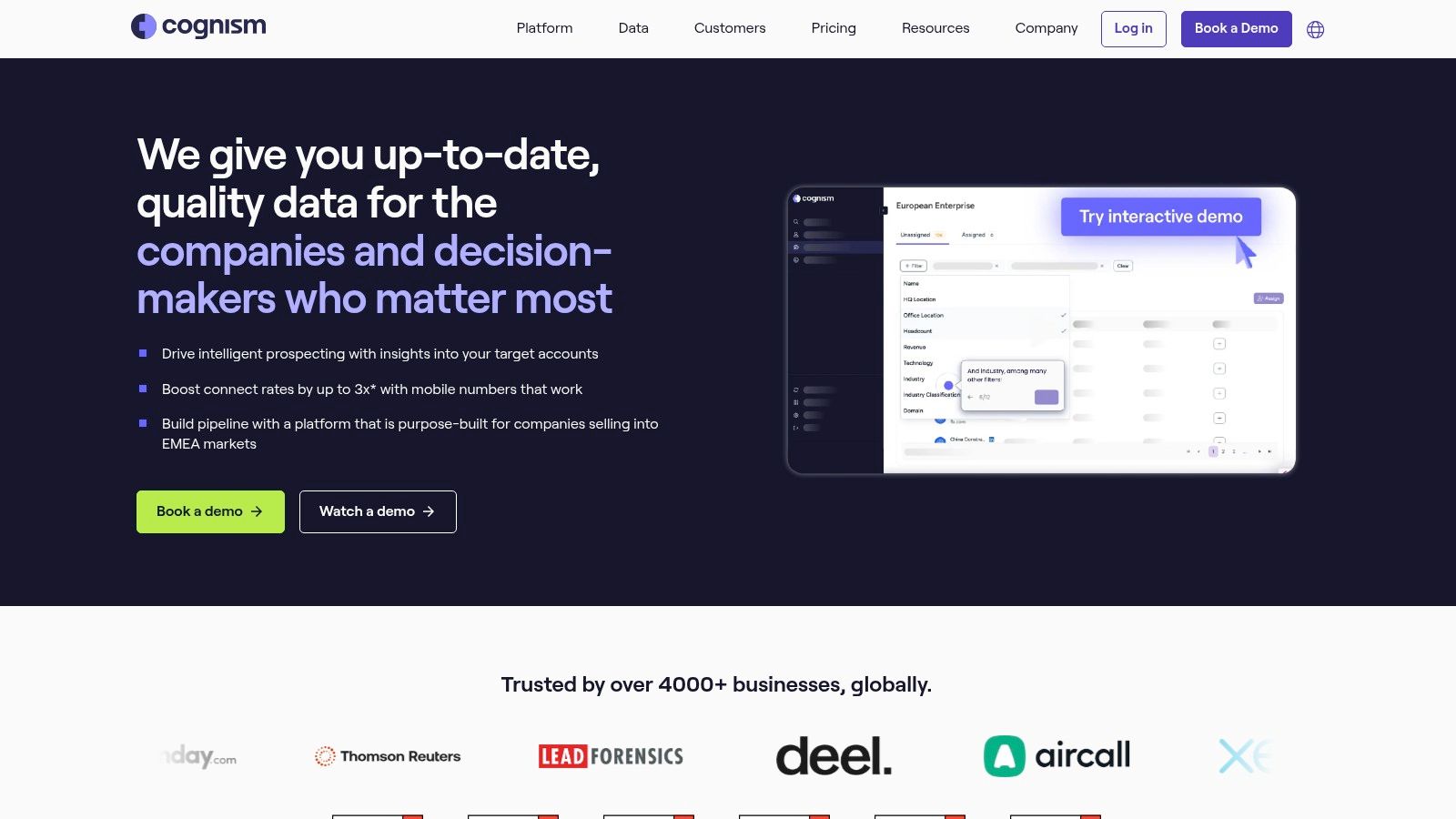
The platform provides sales and marketing teams with direct dials and verified B2B emails to build targeted account lists. While it doesn't have native sequencing like some all-in-one solutions, it integrates seamlessly with popular sales engagement tools, enriching them with its premium data. This focus on data quality over breadth of function makes Cognism one of the best AI lead generation tools for organizations aiming to boost connect rates and minimize wasted outreach efforts.
Key Features & Use Case
- Diamond Data: Access to phone-verified mobile numbers, which are manually checked by a research team. This is perfect for outbound sales teams whose key performance indicator is conversations held, not just emails sent.
- Intent Data & Browser Extension: Identify accounts actively researching solutions like yours and find key contacts on the spot while browsing company websites or LinkedIn profiles.
- Data Enrichment & Compliance: Automate the cleaning and enrichment of your CRM data via API or batch uploads, ensuring your database remains accurate and compliant with global privacy laws.
Pricing is quote-based and requires an annual commitment, which positions it as a premium solution compared to many self-service SMB tools. Free access is generally restricted to limited data samples or short trials, requiring a conversation with their sales team to get started. While this entry barrier is higher, the ROI often comes from the significant improvement in connect rates and meeting bookings.
Website: cognism.com
5. Clearbit
Clearbit, now part of HubSpot, is a data activation platform that excels at real-time enrichment and identifying anonymous website traffic. It's less of a standalone prospecting tool and more of a data engine designed to make your existing marketing and sales stack smarter. For organizations heavily invested in inbound marketing, Clearbit powers the conversion of visitors by shortening forms and providing immediate, deep firmographic context to your CRM.
Its core function is to take a single data point, like an email address or a corporate domain, and return over 100 attributes, including company size, technology used, and employee roles. This makes it a critical component for AI lead generation tools focused on scoring, routing, and personalizing experiences for inbound leads. Because of its HubSpot integration, it's a go-to choice for teams operating within that ecosystem.
Key Features & Use Case
- Real-Time Inbound Enrichment: Automatically enriches new leads from web forms the moment they convert, enabling immediate and accurate lead routing and scoring. This is perfect for marketing ops teams aiming to improve speed-to-lead.
- Website Visitor Identification: Identifies anonymous companies visiting your website, allowing you to trigger targeted advertising campaigns or alert sales teams for proactive ABM outreach.
- Developer-First APIs: Offers robust and well-documented APIs for creating custom data workflows, making it a favorite for RevOps teams with engineering resources who need to integrate data across multiple systems.
Pricing is often opaque and usage-based, which can become costly at scale. Since the HubSpot acquisition, direct subscriptions have become limited, with the platform's capabilities increasingly bundled within HubSpot's offerings. This shift makes it less of a standalone option for teams outside the HubSpot universe. When evaluating data quality and depth, it's useful to compare it against other top data enrichment tools to ensure it fits your specific needs.
Website: clearbit.com
6. Clay
Clay operates as a highly flexible prospecting and enrichment workspace, setting itself apart from more rigid, all-in-one platforms. Its core strength lies in its composable, spreadsheet-like interface that allows users to connect over 100 data sources, run web scraping, and use AI agents to build custom prospecting "recipes." This makes it one of the most powerful AI lead generation tools for technical GTM teams who need full control over their data discovery and personalization workflows.
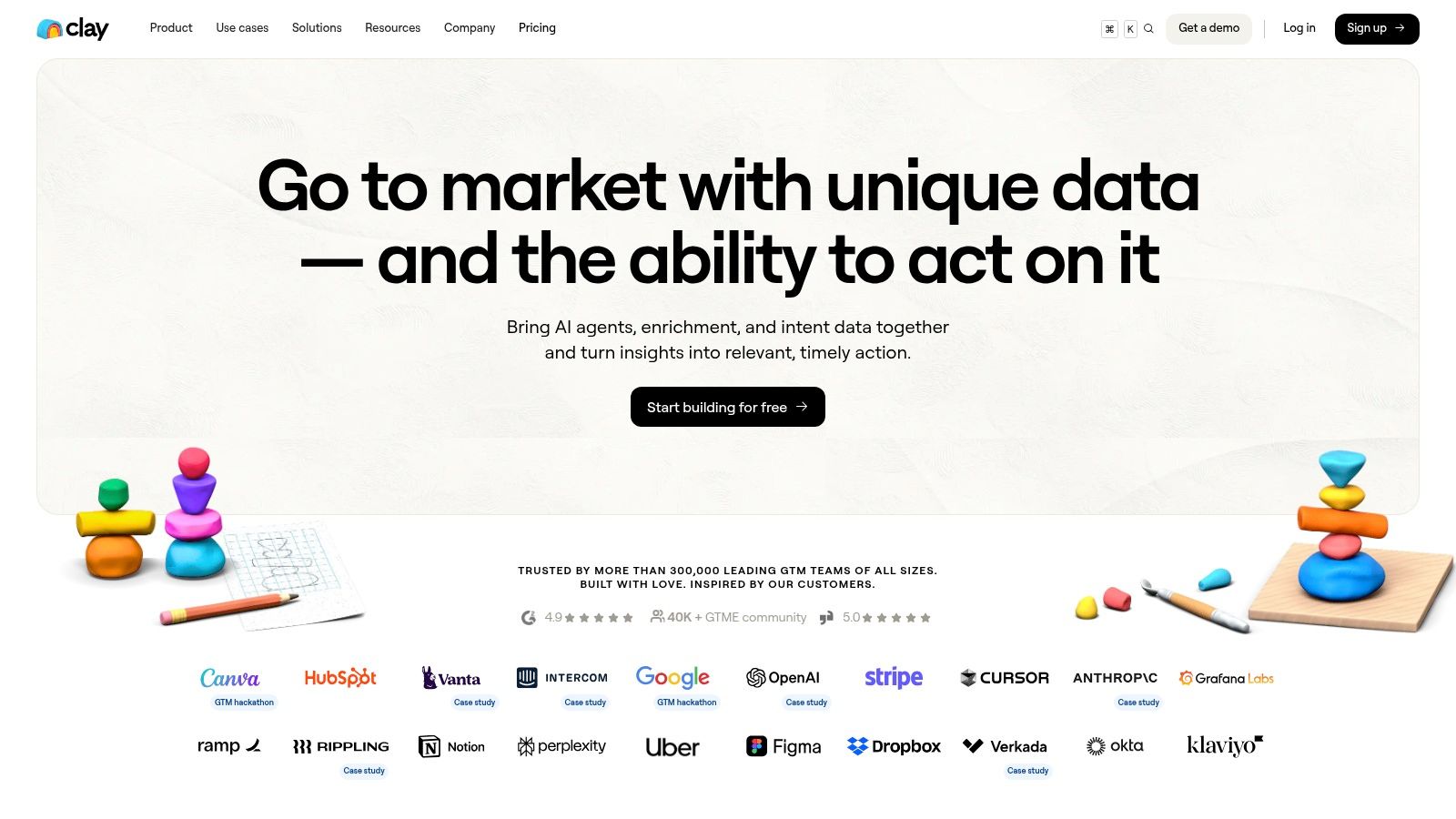
Rather than providing a single, monolithic database, Clay aggregates multiple providers, letting you waterfall enrichments to find the best possible data point for each lead. The platform's AI agent, "Claygent," can be instructed to perform research tasks like visiting a prospect's LinkedIn profile to find a recent post or checking their company's website to identify a relevant case study, all within an automated workflow.
Key Features & Use Case
- Composable Data Workflows: Stitch together data from providers like PeopleDataLabs, Clearbit, and Dropcontact in a single table. This is ideal for RevOps teams building bespoke lead scoring and enrichment models.
- AI Agent (Claygent): Automate manual research tasks by giving plain-English instructions to an AI agent, which can browse websites and analyze content to find personalization hooks.
- Integrated Web Scraping: Pull specific data points directly from websites without needing separate scraping tools, perfect for sourcing niche information that isn't available in standard databases.
Clay's pricing is credit-based, but credits roll over, and all plans include unlimited users. The platform requires a degree of technical and operational skill to configure and manage complex workflows. Since it focuses primarily on data discovery and enrichment, you'll need a separate tool for sending outreach. For those exploring simpler, more integrated systems, it's helpful to investigate a Clay alternative that might better suit your team's technical resources.
Website: clay.com
7. Lusha
Lusha excels in providing straightforward and reliable B2B contact discovery. It's designed for sales teams that need quick access to verified direct dials and email addresses without the complexity of an all-in-one platform. Its primary value is acting as a high-quality data enrichment layer that integrates directly into existing CRMs and sales engagement tools, making it a simple but powerful addition to any tech stack.
The platform operates on a clean, credit-based model and is known for its user-friendly browser extension, which allows reps to find contact information directly from LinkedIn profiles or company websites. While it doesn't offer the native sequencing or AI writing of full-suite AI lead generation tools, it focuses on doing one thing exceptionally well: delivering accurate contact data. This focus makes it a preferred choice for teams who are happy with their current outreach tools but need to improve data accuracy and connect rates.
Key Features & Use Case
- Low-Friction Data Access: The browser extension and simple UI make it easy to find contact information with minimal training. This is ideal for individual SDRs or small teams testing outbound motions.
- CRM & API Integration: Lusha integrates with major CRMs like Salesforce and HubSpot, automatically enriching records and reducing manual data entry for RevOps teams.
- Predictable Credit System: The credit model is transparent, with monthly rollovers on paid plans. This helps managers budget for data acquisition costs without unexpected spikes.
Lusha offers a generous free plan, making it easy to trial its data quality. However, the cost structure is something to consider; phone numbers consume significantly more credits than emails, which can make the platform expensive for teams heavily reliant on cold calling. Its dataset, while accurate, is also not as broad as some larger enterprise-grade competitors.
Website: lusha.com
8. Seamless.AI
Seamless.AI positions itself as a real-time B2B search engine, designed to quickly surface direct-dial phone numbers and verified emails for sales outreach. Its core strength lies in providing a straightforward path to obtaining contact data, including mobile numbers, even on its entry-level plans, which makes it an attractive option for teams prioritizing phone-based prospecting. The platform is one of the more accessible AI lead generation tools, with a system of daily-refreshed credits on higher tiers that encourages consistent usage.
The platform's AI engine works in real-time to find and validate contact information, reducing the risk of list decay. Beyond basic contact discovery, Seamless.AI includes features like buyer intent data and job change tracking, allowing sales reps to time their outreach more effectively. An optional "Connect" module adds basic sequencing capabilities, though many teams integrate it with more robust sales engagement platforms.
Key Features & Use Case
- Real-Time Search Engine: Find verified mobile numbers and emails directly through its web app or browser extension. This is ideal for SDRs who need immediate access to contact data for calling-heavy campaigns.
- Buyer Intent & Job Change Alerts: Get notifications when target accounts show purchase intent or key contacts switch roles. This helps sales teams prioritize the most opportune accounts and maintain relationships.
- Data Enrichment API: Automate the process of cleaning and enriching inbound leads or existing CRM records, ensuring your database remains accurate and complete.
Seamless.AI offers a free trial path that includes credits for both emails and phone numbers, allowing teams to test its data quality. As needs expand, users can add on modules for more advanced features. However, pricing for paid tiers is not transparent online and requires a sales call, and some users have noted the importance of carefully reviewing renewal terms.
Website: seamless.ai
9. 6sense Sales Intelligence
6sense Sales Intelligence moves beyond simple contact databases by blending account intent, technographics, and predictive AI to show sellers which accounts are actively in-market. This platform is designed to bridge the gap between Account-Based Marketing (ABM) strategies and the practical needs of SDR prospecting. It prioritizes accounts based on buying signals, making it one of the more strategic AI lead generation tools for teams focused on their Ideal Customer Profile (ICP).
The platform identifies anonymous web visitors, tracks third-party research activity, and uses predictive models to score accounts on their buying journey stage. This allows sales teams to stop guessing and instead concentrate their efforts on prospects demonstrating clear intent. A standout feature is its generous free tier, which provides a risk-free way to test the core company and contact data before committing to the more advanced predictive capabilities.
Key Features & Use Case
- Predictive AI & Intent Data: The platform's main strength is identifying and prioritizing in-market accounts, telling sellers not just who to contact but when. This is perfect for enterprise sales teams running targeted ABM plays.
- Free Data Tier: A free plan with contact credits, company search, and alerts provides a solid on-ramp to validate data quality and user experience.
- Web Visitor Identification: See which companies are visiting your website, even if they don't fill out a form, turning anonymous traffic into actionable leads.
Full platform pricing is quote-based and can become complex, as it may include separate fees for advertising and data packages that require negotiation. While the free plan is a strong entry point, accessing the full suite of predictive features demands a significant investment.
Website: 6sense.com
10. Demandbase One (Sales Intelligence)
Demandbase One shifts the focus from individual leads to entire accounts, unifying third-party intent signals, first-party engagement data, and contact information. It's built to tell sellers not just who to target but also when to engage. This platform acts as a bridge between enterprise-level Account-Based Marketing (ABM) and sales execution, delivering prescriptive dashboards and AI-driven actions directly into existing seller workflows.
The platform's strength lies in its ability to synthesize multiple data streams to surface high-value accounts that are actively in-market. For revenue teams, Demandbase One offers a clear path from identifying a promising account to engaging the right people within it. Its use of AI agents for recommending next-best actions makes it a powerful example of AI lead generation tools designed for complex, high-value sales cycles where timing and context are critical.
Key Features & Use Case
- AI-Driven Recommendations: Uses AI to recommend accounts and contacts by tracking an enormous range of intent signals, perfect for enterprise teams needing to prioritize efforts across large territories.
- Prescriptive Seller Workflows: Integrates directly with CRMs like Salesforce and outreach platforms to guide sellers with next-best-action suggestions, ensuring marketing insights translate to sales activity.
- Agentbase AI Automation: Deploys AI agents to automate go-to-market tasks, such as identifying new contacts in a buying committee or flagging accounts that show a sudden spike in interest.
Pricing is custom and typically geared toward enterprise budgets, which may place it out of reach for smaller organizations or those with straightforward lead discovery needs. The platform's extensive capabilities can also present a steep learning curve and may be more than what a team focused on simple top-of-funnel prospecting requires. However, for large sales and marketing teams aligned around an ABM strategy, its deep account intelligence is a significant advantage.
Website: demandbase.com
11. Amplemarket
Amplemarket presents an integrated sales stack designed to replace multiple point solutions for outbound teams. It bundles a global B2B database, AI-powered intent signals, and multichannel sequencing capabilities into one platform. This makes it a strong contender among AI lead generation tools for SDR teams looking for a practical, all-in-one system with transparent entry-level packaging.
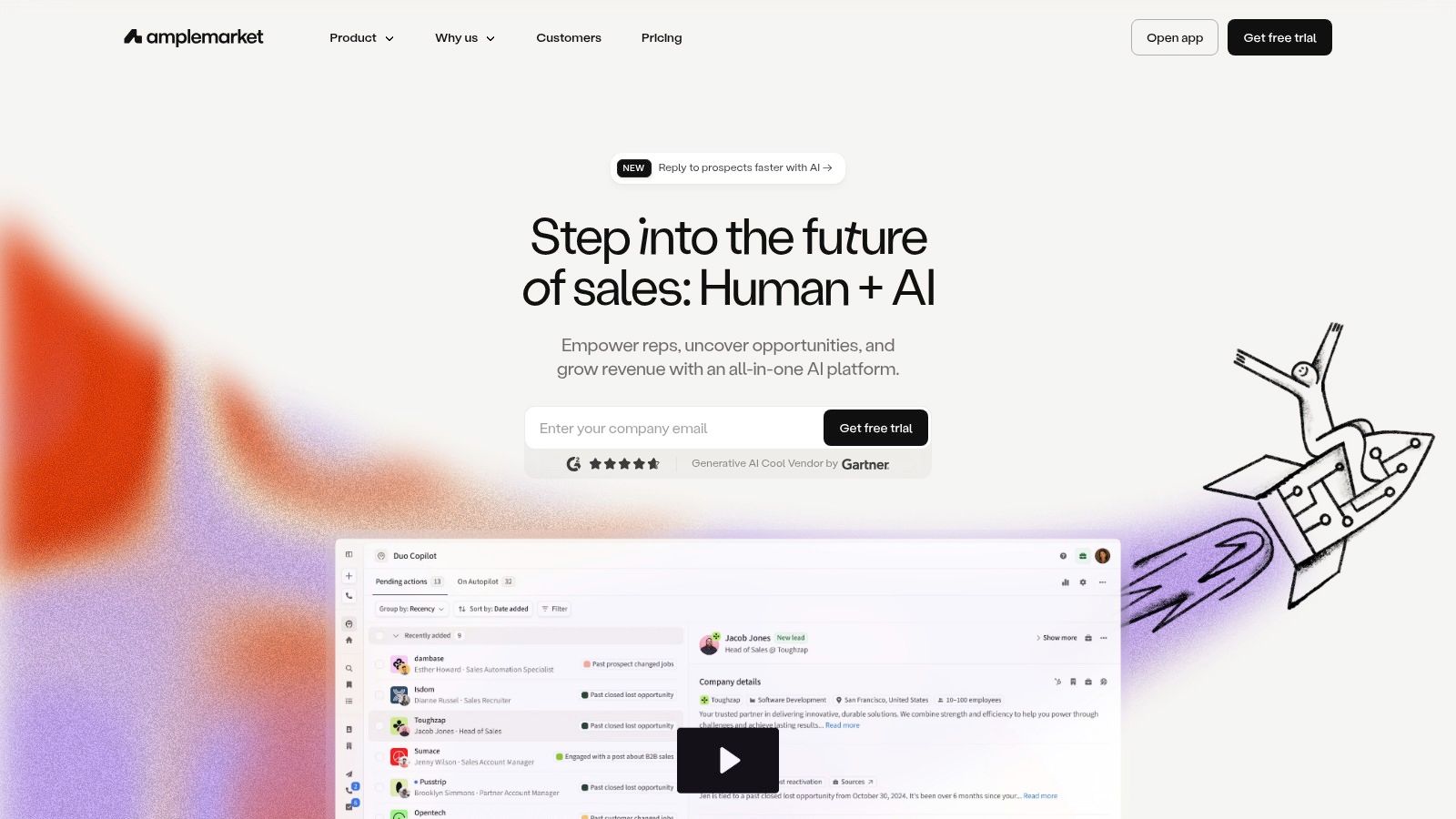
The platform's core strength is its unified workflow, allowing users to move from lead discovery and data enrichment to sequence execution without switching applications. An AI Copilot assists in drafting personalized emails and entire sequences, while built-in deliverability and warmup tools help maintain domain health. This combination of data, outreach automation, and supporting tools provides a cohesive environment for building and scaling prospecting efforts from scratch.
Key Features & Use Case
- Integrated Data & Sequencing: Discover leads within the platform's database and immediately enroll them in AI-generated multichannel sequences. This is perfect for SDR teams needing to consolidate their tech stack and streamline operations.
- AI Copilot & Intent Signals: The AI assistant helps generate outreach copy and identifies prospects showing buying intent, allowing for more timely and relevant engagement.
- Deliverability & Analytics: A dedicated domain health center and warmup tools are included, which is critical for teams focused on maintaining high email deliverability. The analytics provide clear insights into campaign performance.
Amplemarket offers transparent entry-level pricing with clear allocations for contact and phone credits, which is a significant advantage for teams managing tight budgets. However, while the all-in-one approach is convenient, it's wise to pilot the platform to validate that its data quality and volume meet the needs of your specific Ideal Customer Profile (ICP). Higher tiers and add-ons like the AI Voice/Inbox features require custom quotes.
Website: amplemarket.com
12. LeadIQ
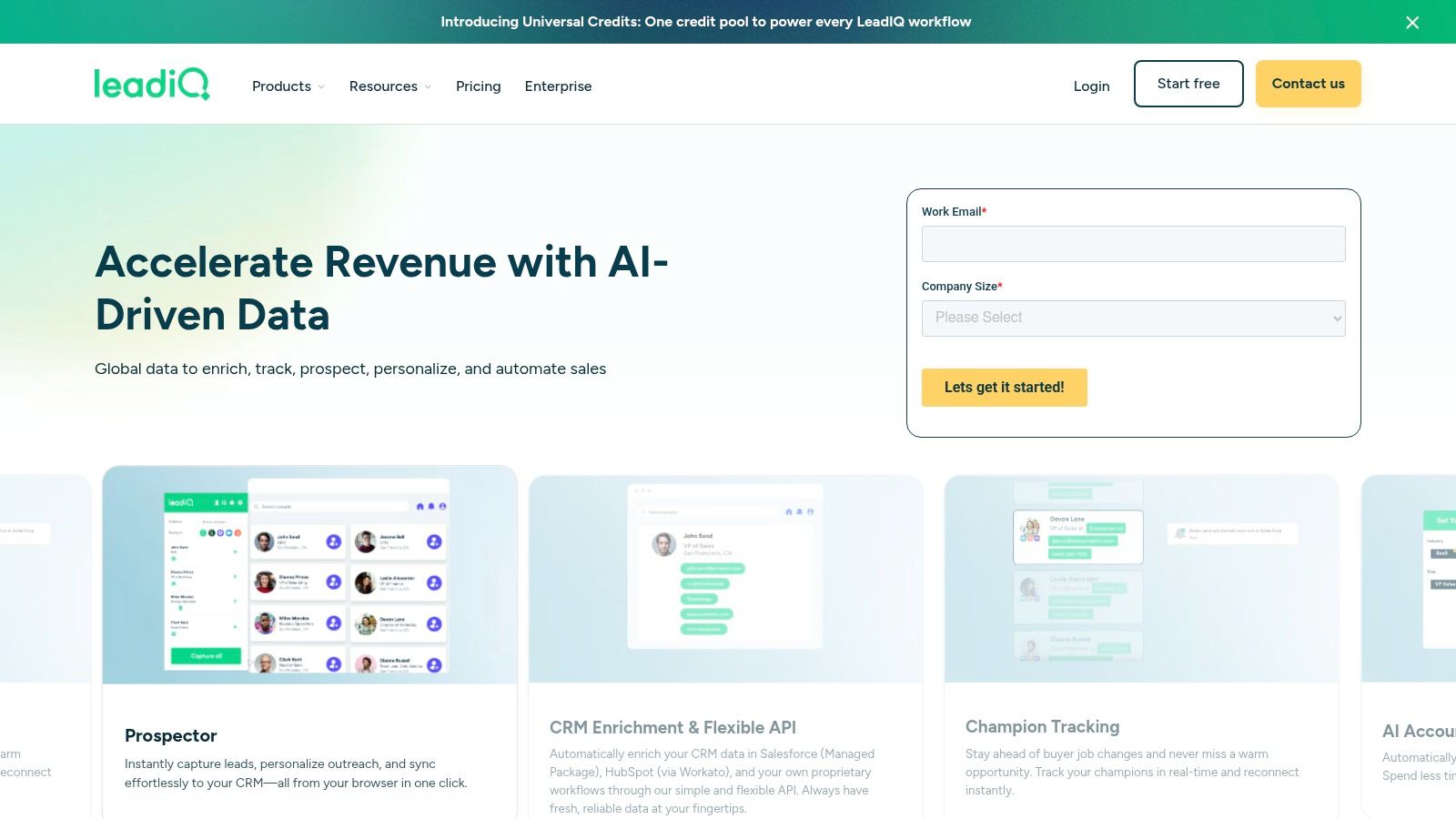
LeadIQ specializes in accelerating prospect discovery and outreach, positioning itself as a key tool for sales development representatives (SDRs) who need to build lists quickly. Its primary strength lies in its intuitive Chrome extension that allows for rapid capture of prospect data directly from LinkedIn and other websites. The platform focuses on providing verified contact information, including emails and mobile numbers, and pushes this enriched data directly into a user's CRM.
This workflow-centric design makes it one of the more popular AI lead generation tools for teams prioritizing speed and efficiency in their initial outreach. By integrating data capture, verification, and AI-powered message writing, LeadIQ reduces the manual steps needed to move from prospect identification to the first touchpoint.
Key Features & Use Case
- Fast Prospect Capture: The Chrome extension is the core of the product, designed for SDRs to quickly capture contacts from LinkedIn Sales Navigator and corporate websites, minimizing context switching.
- AI Message Generation: The "Scribe" AI writer analyzes a prospect's LinkedIn profile to generate personalized email openers and messages, helping reps craft relevant outreach faster.
- Job Change Alerts & Signals: Users receive notifications when target contacts change jobs and can track signals like podcast appearances or company mentions to time outreach effectively. This is ideal for account-based sales motions.
LeadIQ offers a freemium plan to test the core functionality, with paid tiers unlocking more credits and features. A significant consideration is the credit system, where mobile numbers often cost more credits than emails. While this model provides clear cost controls, teams that rely heavily on cold calling may find their expenses increasing quickly. The platform's simplicity and direct focus on the SDR workflow make it a strong choice for teams that need to equip reps with an easy-to-use prospecting tool without overwhelming them.
Website: leadiq.com
Top 12 AI Lead Generation Tools Comparison
| Tool | Quality & Accuracy | Value & Pricing | Best For | Unique Strength |
|---|---|---|---|---|
| RevoScale | 97%+ accuracy, sub-2s enrich | Flat tiers $49-$349/mo, no per-email credits | RevOps, SDRs, agencies | AI waterfall (50+ providers), plain-English ICP |
| Apollo.io | Variable data; good UX | Tiered + credit model (mobile costlier) | SMB to midmarket sales | Large DB + built-in sequencing & dialer |
| ZoomInfo SalesOS | Broad enterprise dataset | Quote-based; contracts & credits | Large enterprises & RevOps | Mature ecosystem & add-ons |
| Cognism | Strong mobile accuracy | Quote-based, premium | Teams needing compliance & mobile | Diamond Data (phone-verified mobiles) |
| Clearbit | Developer-friendly, real-time | Usage-based; HubSpot ties | HubSpot/ABM and inbound teams | Real-time enrichment + APIs |
| Clay | Flexible but ops-heavy | Subscription with unlimited users | Technical composable workflows | Agentic prospecting recipes + scraping |
| Lusha | Easy and fast | Credit-based with free tier | Small teams & quick trials | Low-friction onboarding + free credits |
| Seamless.AI | Variable; phones in base | Starter credits incl. phones | Teams wanting phones in starter | Daily-refreshed starter credits |
| 6sense | Strong account intent | Quote-based; free on-ramp | ABM teams & ICP-focused sellers | Predictive models + Sales Copilot |
| Demandbase One | Prescriptive ABM insights | Custom enterprise pricing | Enterprise ABM & GTM teams | AI agents for next-best-action |
| Amplemarket | Integrated execution stack | Transparent entry pricing | SDR teams seeking all-in-one | Deliverability + warmup + AI drafts |
| LeadIQ | Fast capture; reliable | Freemium + credits | SDRs needing fast capture | LinkedIn capture + quick enrichment |
Making Your Final Choice: How to Select and Implement the Right Tool
We've explored a dozen of the most powerful AI lead generation tools on the market, from all-in-one workhorses like Apollo.io and RevoScale to specialized intent data platforms like 6sense and Demandbase. Each offers a distinct set of strengths, whether it's the sheer database size of ZoomInfo, the creative automation of Clay, or the targeted compliance of Cognism. The common thread is clear: AI is no longer a peripheral feature but the core engine driving modern prospecting efficiency.
The sheer volume of options can feel overwhelming, but making the right decision doesn't have to be a monumental task. The best platform for your organization is the one that directly solves your most significant pipeline bottleneck. Instead of chasing the tool with the longest feature list, begin with a focused internal audit.
A Practical Framework for Your Final Decision
To move from this extensive list to a confident final selection, adopt a structured evaluation process. This prevents you from being swayed by a slick demo and grounds your choice in your team's actual needs.
- Identify Your Core Pain Point: Before you look at another product page, define the primary problem you need to solve. Is it inaccurate contact data that leads to high bounce rates? Is it the hours your SDRs spend manually researching prospects? Or is it a struggle to identify which accounts are actively in-market? Be specific. Your number one problem is your number one evaluation criterion.
- Align with Your Team's Scale and Expertise: The needs of a two-person startup are fundamentally different from those of a 50-person sales development team.
- Startups & SMBs: Look for all-in-one platforms with predictable pricing and a minimal learning curve. Tools like RevoScale or Amplemarket offer a strong blend of data, sequencing, and enrichment without requiring a dedicated operations manager.
- Mid-Market & Enterprise: Your focus should be on data quality, integration capabilities, and advanced features like intent signals and territory planning. Platforms like ZoomInfo, 6sense, or Cognism are built to support more complex go-to-market motions and integrate deeply into a mature tech stack.
- Agencies: Flexibility is your greatest asset. Consider platforms like Clay that allow for creative, multi-step workflows, or data providers like Lusha that offer flexible credit-based plans to service multiple clients.
- Run a Competitive Pilot Program: Never make a decision based on marketing materials alone. Select your top two or three contenders and run a head-to-head trial.
- Use a Real-World Sample: Give each platform the same list of 50-100 target accounts.
- Measure Key Metrics: Compare them on critical outputs: What percentage of contacts had a verified email? How many direct-dial mobile numbers were found? How easy was it to build a sequence?
- Gather Team Feedback: The best tool is the one your team will actually adopt. Involve the end-users (your SDRs) in the pilot and listen to their feedback on workflow and usability.
Beyond the License: Successful Implementation
Choosing the right tool is only half the battle; successful implementation determines your ROI. Don't just "turn on" the platform and expect magic. A thoughtful rollout is critical.
First, plan for data hygiene. Before importing thousands of new contacts from your chosen AI lead generation tool, clean up your existing CRM data. Archive old, inactive records and standardize formatting to prevent creating a bigger mess.
Second, invest in proper training. Schedule dedicated sessions that go beyond the vendor's basic onboarding. Create internal documentation with best practices specific to your sales process. Show your team how the new tool fits into their day-to-day workflow, from building a target list to launching an outreach sequence. This small upfront investment pays huge dividends in adoption and performance.
Finally, define and track success metrics. What does a win look like? Is it a 15% increase in meetings booked? A 50% reduction in time spent on manual research? Set clear, quantifiable goals and review them quarterly to ensure the platform is delivering on its promise and proving its value to the business.
Feeling overwhelmed by the options but know you need a more efficient way to build pipeline? RevoScale is designed as a powerful, all-in-one AI lead generation platform that combines a verified B2B database, unlimited email enrichment, and multi-channel sequencing in a single, easy-to-use interface. See how you can build qualified lead lists and automate outreach in minutes by exploring RevoScale today.