
Email Outreach
|2026-03-08
How to Send a Proper Email That Gets Opened and Replied To
Learn the complete system for crafting B2B emails that actually get replies. From subject lines to CTAs, discover how to build outreach on accurate data and hyper-personalization at scale.
Ever wonder why some cold emails get replies while most get instantly deleted? It's not about some secret template or magic phrase. The emails that actually start conversations are built on a solid framework: knowing exactly who you're talking to, having something compelling to say, and making it dead simple for them to respond.
This isn't just about writing—it's about a repeatable system that turns a cold list into warm leads. This guide breaks down that system into actionable steps you can implement today.
The Blueprint for a Reply-Worthy B2B Email

Before you even think about hitting "send," you need to understand what goes into an email that works. Too many sales reps obsess over the body copy, but that's just one piece of the puzzle. An email that actually lands a meeting is a careful mix of the right person, the right timing, and the right message.
The real goal here is to move past generic pitches. You want to create outreach that feels personal, relevant, and genuinely valuable to the person on the other end.
Start with a Solid Foundation: Accurate Data
Let's be blunt: the entire process is built on accurate data. You can write the most persuasive, brilliant email in history, but it's completely worthless if it's sent to the wrong person, references an old job title, or bounces.
In B2B sales, your credibility is everything. Bad data destroys it in a single click.
The difference between an email that gets deleted and one that starts a relationship often comes down to one thing: did the sender do their homework? Showing you understand your prospect's world is the fastest way to earn their attention.
This is why using a platform like RevoScale is the essential first step. When you're building outreach on a foundation of 97%+ data accuracy, you can be confident you're working with verified, current information. We're not just talking about emails, but the critical context—like company size, technographics, and direct-dial mobile numbers.
If you want to go deeper on building high-quality prospect lists, our guide on sales prospecting best practices is a great place to start.
The Core Components of Every Winning Email
To break it down, every high-performing B2B email has a few key parts that must work together. Think of it as a pre-flight checklist for every campaign you launch.
This table summarizes the essential components that every effective B2B email needs to get right.
Anatomy of a High-Performing B2B Email
| Component | Purpose | Key Metric |
|---|---|---|
| Subject Line & Preview | Earn the open without being misleading. | Open Rate |
| Personalized Opening | Prove you've done your research in the first sentence. | Reply Rate |
| Clear Value Proposition | Quickly answer "what's in it for me?" for the reader. | Positive Reply Rate |
| Simple Call-to-Action | Make the next step obvious and low-friction. | Meeting Booked Rate |
| Professional Signature | Provide legitimacy and easy access to more info. | Click-Through Rate |
Mastering these elements is about treating your email less like a message and more like a product. It needs to be well-designed, perfectly targeted, and solve a real problem for the user—your prospect. In the next sections, we'll dig into exactly how to craft each one.
Crafting Subject Lines That Demand to Be Opened

Your subject line is the gatekeeper. It's the first—and maybe only—thing a prospect sees. You have a split second to convince a busy decision-maker that your email is worth opening over the dozens of others piling up.
Let's be real, the old tricks don't work anymore. Generic, clickbait-y subject lines are a one-way ticket to the trash folder, or worse, the spam filter. The goal isn't to trick someone into opening your email. It's to earn their attention by being immediately relevant.
Go Beyond the Generic Playbook
The best subject lines aren't born from a template. They come from a simple shift in thinking. Instead of asking, "What will make them click?" you should be asking, "What's happening in their world right now that makes my email relevant?"
This is where you need to move beyond just finding an email address. You need context. Using a tool like the unlimited email finder from RevoScale, for example, can arm you with the specific details needed to craft a compelling message. Did their company just announce a new funding round? Are they hiring a ton of new sales reps? That's gold.
A subject line built around a specific, timely data point will always outperform a generic one. It instantly shows you've done your research and you're not just another random vendor—you're a potential partner who understands their situation.
So how does this look in practice? Let's break it down. Instead of a vague subject line that gets instantly deleted, you can use a specific trigger event.
Weak Subject Line: "Quick Question"
- Why it fails: We've all seen it, and we all delete it. It's overused, creates zero curiosity, and just feels like a lazy setup for a sales pitch.
Strong Subject Line: "Question re: your new SDR hires"
- Why it works: It's specific, it's relevant, and it makes the prospect think, "Okay, what do they know about my new hires?" You've created targeted curiosity, which is the key to getting that open.
Real-World Examples for Better Open Rates
Here are a couple more side-by-side comparisons. See how a little bit of research and personalization changes the entire feel of the outreach?
- Vague: "Intro to RevoScale"
- Personalized: "Idea for your outbound team at [Company Name]"
- Generic: "15 minutes next week?"
- Data-Driven: "Saw you use [Competitor Tech], thought of this"
These personalized subject lines work because they're grounded in the prospect's reality. They prove you have a basic understanding of their business, which is the first step in learning how to send a proper email that actually starts a conversation.
While many tools like Hunter.io are great for finding email addresses, a true Hunter.io alternative like RevoScale will also give you the rich company and contact data you need to pull off this level of effective personalization.
The Opening Line and Value Prop That Actually Gets Read
You've got about three seconds. That's it. Once your email is opened, you have a tiny window to prove it's not just another piece of inbox clutter. This is where most outreach falls apart, usually with a tired opening like, "Hope you're having a great week." Let's agree to retire that one for good.
The best way to start is by immediately showing them why you're emailing them and why you're doing it now. I call this a "Relevance Trigger." It's a specific, timely observation about their world, not yours. Did they just announce a funding round? Did the VP of Sales you're targeting just post an interesting article on LinkedIn? Maybe you noticed they're hiring a dozen new SDRs. That's your trigger.
Honestly, finding these triggers used to be a grind. You'd spend an hour digging through news articles and LinkedIn profiles for a single nugget. That's where good enrichment data becomes a game-changer. Instead of manual research, platforms like RevoScale can surface over 50 data points on a contact in sub-2-seconds, giving you a whole menu of relevant triggers to choose from.
From Hook to Value: Answering "What's In It For Me?"
Once you have their attention with a solid opening, you have to pivot quickly to what you can do for them. This isn't the time to list all your amazing features. Nobody cares. They care about their own problems.
A simple but powerful way to frame this is the Problem-Agitate-Solve (PAS) model. It's a classic for a reason—it works by tapping directly into your prospect's daily challenges.
- Problem: Lead with a challenge you know is common for someone in their role or industry.
- Agitate: Gently twist the knife. What happens if this problem goes unsolved?
- Solve: Present your solution as the clear and obvious way out of that mess.
Let's see how this looks in the real world. Imagine you're emailing a RevOps leader who just hired a bunch of new SDRs.
Opening Trigger: "Saw the announcement about your new SDR hires on LinkedIn—congrats on the team's growth."
Problem: "I know from experience how tough it can be to get new reps ramped and hitting quota, especially when they're stuck with bad contact data."
Agitate: "It's a huge time-sink that tanks morale and stalls the pipeline before it even gets going."
Solve: "We help by providing a list of B2B contacts with 97%+ accuracy, so your new team can spend their time actually selling."
See the difference? You've gone from a generic pitch to a focused, consultative message. You've shown you understand their world and have a direct, tangible solution for a pain they are likely feeling right now. Connecting your value to their specific business problem isn't just a nice-to-have; it's the single fastest way to earn a reply.
Achieving Hyper-Personalization at Scale
Let's be honest, we all know what happens to a generic email—it gets archived or deleted in seconds. In a world of overflowing inboxes, just plugging in a {FirstName} tag is the absolute bare minimum. It's not personalization; it's just mail merge.
True personalization, the kind that actually gets a response, is about demonstrating that you understand your prospect's unique world. It's about showing you've done your homework on their company, their challenges, and their current situation. When you nail this, your outreach feels less like a mass-produced template and more like a helpful, one-to-one conversation.
It all boils down to connecting a specific trigger (something you noticed about them) to the value you can provide.
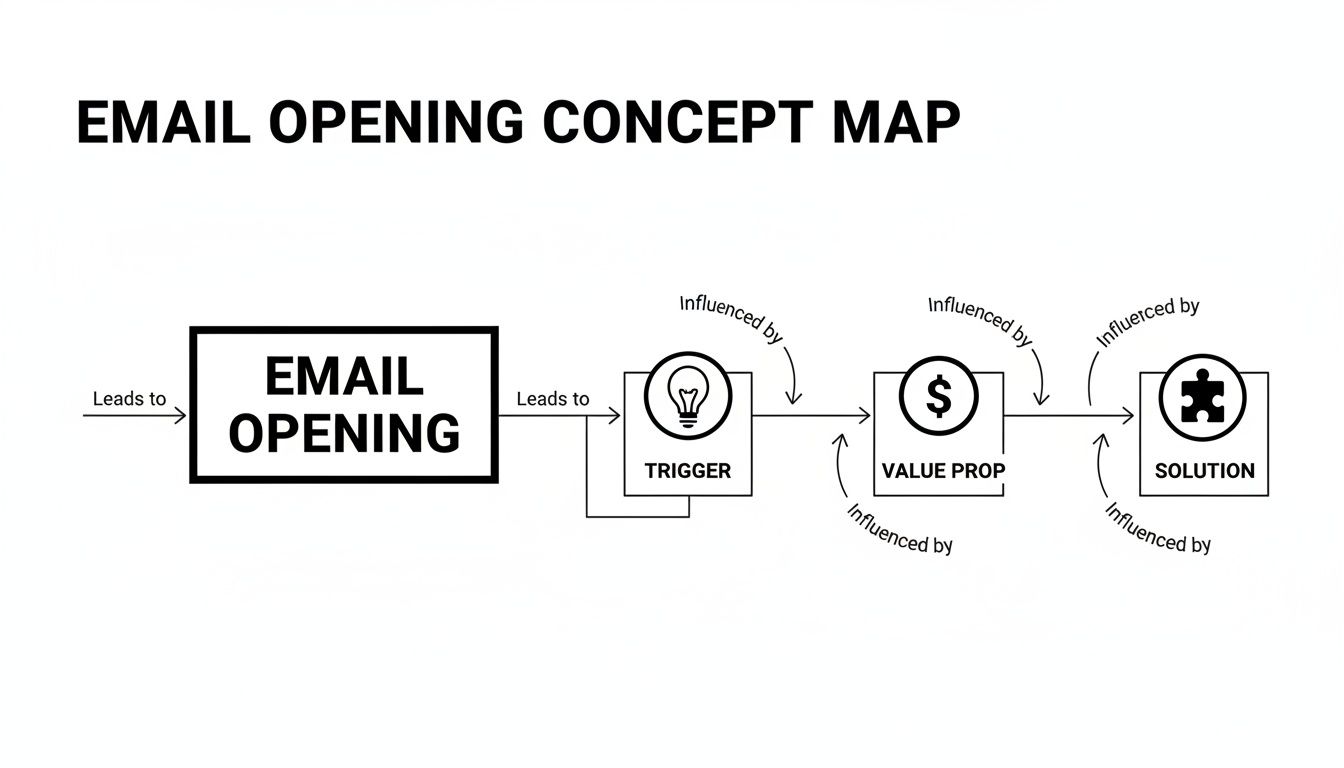
The trick is making that connection feel genuine and relevant, even when you're emailing hundreds of people a week.
Turning Data Into Compelling Messages
So, how do you find these triggers without spending hours manually researching every single prospect? The secret is using rich B2B data to do the heavy lifting for you. Data enrichment tools can surface the exact insights you need in seconds, giving you the fuel for truly relevant outreach.
You can pull from different types of data to create unique personalization angles:
- Firmographic Data: This is the basic company info—industry, employee count, annual revenue. It helps you speak to their high-level business goals and pains.
- Technographic Data: This reveals the specific technology stack a company uses. It's gold for positioning your solution against a competitor or an outdated tool they're stuck with.
- Intent Signals: These are powerful buying signals. Think recent funding announcements, hiring sprees for specific roles, or a surge in online research around a particular topic. They give you a perfect, timely reason to reach out.
Tools like RevoScale give you access to this kind of data across more than 50 fields, creating a deep well of information to draw from. If you're not sure exactly who to target with all this great data, take a look at our guide for building an ideal customer profile template.
The table below shows how you can translate a simple data point into a powerful, personalized hook for your email.
Data Point to Personalization Angle
| Data Point (from RevoScale) | Personalization Angle | Example Snippet |
|---|---|---|
| New CMO Hired | Acknowledge their new leadership and tie it to a common challenge for incoming executives. | "Saw that you just brought on a new CMO—congrats to the team! New leaders often look to re-evaluate their tech stack in the first 90 days to drive quick wins." |
| Using a Competitor's Product | Acknowledge their current tool and highlight your key differentiator that solves a common pain point. | "Noticed your sales team is using [Competitor X]. I was curious how you're handling their per-seat pricing as you scale, since that can get expensive fast." |
| Hiring 10+ New SDRs | Connect their team growth to a future operational challenge your product solves. | "Saw on LinkedIn that you're hiring a new class of SDRs. Ramping that many new reps at once is a huge undertaking—getting them access to accurate mobile numbers will be key." |
| Recent M&A Activity | Tie the company's major strategic move to the need for streamlined systems. | "Congrats on the recent acquisition of [Company Y]! Merging two different sales processes can be complex, especially when it comes to consolidating customer data." |
By weaving these data-driven hooks into your opening lines, you immediately prove your relevance and earn the right to your prospect's attention.
Real-World Personalization Scenarios
Let's walk through how this looks in the real world. Say you're an SDR selling a sales intelligence platform. With enriched data, you can ditch the generic pitch and get straight to the point.
Scenario 1: Competitor Displacement
Your data shows the prospect uses a credit-based competitor like Apollo.io.
Your Angle: "Saw your team is using Apollo for data. I was curious how you're navigating the credit limits as your team scales, since I know that can become unpredictable. Our flat-rate model offers unlimited usage for a fixed cost, so your reps never have to slow down."
This approach works because it shows you've done your homework and immediately hits on a common pain point of a specific competitor. You're not just selling; you're offering a direct solution to a problem they likely already have.
Scenario 2: Timely Event Trigger
The data shows a prospect company just announced a new round of funding.
Your Angle: "Congratulations on the recent Series B funding! That's a huge milestone. As you prepare to scale the sales team, ensuring your new reps have access to 97%+ accurate data will be critical for hitting those aggressive growth targets."
This message is perfect. It's timely, it's complimentary, and it connects their big news directly to a challenge they are about to face—scaling their sales function. You've just proven your relevance from the very first sentence, making a reply far more likely.
Driving Action With a Clear and Simple CTA
You've crafted the perfect opening and a killer value prop. Don't let the email fizzle out at the very end. An email without a sharp, clear call-to-action (CTA) is a missed opportunity, plain and simple. Its entire purpose is to get a response, and your CTA is what tells the prospect exactly what to do next.
If you make them think, you've lost. The single biggest mistake I see reps make is asking for too much, too soon. A "Book a demo" link in a first email is a huge ask from a total stranger. It's high-friction and almost always gets ignored.
Instead, your final sentence should propose a next step that is low-effort, specific, and incredibly easy for them to say "yes" to.
Matching the CTA to the Email's Goal
Your CTA needs to match where your prospect is in their journey. Are you just trying to see if you've hit on a real pain point, or are you genuinely ready to book a meeting? The words you choose here make all the difference.
- Interest-Based CTAs: These are perfect for that first cold email. The goal isn't a meeting; it's just to start a conversation. You're testing the waters with a soft, open-ended question that feels more like a helpful offer than a hard sell.
- "Mind if I share a brief case study on how we helped [Similar Company] with this?"
- "Is this a challenge your team is currently focused on?"
- Time-Based CTAs: Save these for when you have a good reason to believe they're interested—maybe they downloaded a guide or you're following up on a previous "yes." These are more direct but still keep the commitment small and specific.
- "Do you have 15 minutes next Tuesday afternoon to explore how this could apply to your team?"
- "Are you open to a quick call later this week to see if there's a fit?"
The best CTAs feel like a logical next step, not a sudden demand. By proposing a small, specific action, you make it easy for a busy prospect to agree without feeling pressured or needing to check their entire calendar.
Think about the difference. A vague CTA like, "Let me know what you think," puts all the work on the reader. They have to decide what the next step should be, and the easiest choice is to do nothing.
A strong CTA, on the other hand, takes the guesswork out of it. It's the difference between ending with a whimper and ending with a clear path forward. This small shift is what turns a passive reader into an engaged lead and gets more meetings on the calendar.
Keeping Your Emails Out of Spam and Tracking What Works
You can write the most compelling, perfectly personalized email in the world, but it's all for nothing if it gets buried in a spam filter. Getting this right isn't just a technical checkbox; it's the bedrock of your entire outbound strategy. If you can't consistently land in the primary inbox, you're basically invisible.
The quickest way to ruin your sender reputation is with a high bounce rate. Every time you send to an invalid email, you're sending a negative signal to inbox providers like Google and Microsoft. Do it too often, and they'll start treating all your emails as junk.
Protect Your Sender Reputation at All Costs
This is exactly why you have to start with a clean, verified list of contacts. It's not optional. Using a data source like RevoScale, which guarantees 97%+ accuracy and includes unlimited email verification, is your best defense against bounces that can cripple your domain's reputation before you even get started.
On top of that, you have to play by the rules. Regulations like CAN-SPAM in the U.S. and GDPR in Europe are non-negotiable. At a minimum, every email needs a clear unsubscribe link and your company's physical mailing address. The penalties for ignoring this aren't just fines; it's another nail in your deliverability coffin. For a deeper dive on the technical side, our guide on how to validate emails breaks it all down.
Focus on the Metrics That Tell the Real Story
Once you're confidently hitting inboxes, it's time to figure out what's actually working. Don't just glance at the numbers—learn to read them. They're giving you direct feedback from your audience.
Think of it this way: a low open rate is your market telling you the subject line is boring. A high open rate but zero replies means your message missed the mark.
These are the core metrics you should obsess over and what they're telling you:
- Open Rate: This is a direct grade on your subject line and preview text. If the numbers are low, your first impression isn't sparking enough curiosity to earn a click.
- Click-Through Rate (CTR): This shows you who's engaging with your content. A click is a small "yes." It tells you if the value you're hinting at is compelling enough for them to take the next small step.
- Reply Rate: This is the one that really counts. A positive reply means you've hit a nerve. You successfully identified a relevant problem and positioned your offer as a credible solution.
Looking at these metrics together lets you pinpoint exactly where your outreach is falling short. This data-driven feedback loop is how you stop guessing and start systematically improving your messaging with every email you send.
Answering Your Top B2B Email Questions
Let's tackle a few of the most common questions that come up when sales teams are trying to get their outbound emails right. Here's the straight scoop based on what actually works.
How Long Should a B2B Sales Email Actually Be?
Keep it short. Seriously. You should be aiming for 50-125 words, max.
Think about how you read your own email—you scan, you don't read novels. Your B2B email needs to be just as scannable, especially on a phone. The goal is to get your point across in 2-3 quick paragraphs: a personalized opening line, a snapshot of the value you bring, and a simple, low-effort ask. Anything more and you're just inviting a trip to the trash folder.
Is There a "Best" Day and Time to Send Sales Emails?
The classic advice—mid-week mornings like Tuesday through Thursday, between 9-11 AM in their local time—is a great starting point. Most people are settled in but not yet swamped.
But here's the real answer: it depends entirely on your audience. Start with that conventional window, but pay close attention to your own data. Track your open and reply rates and don't be afraid to experiment. The only thing I'd strongly advise against is a Monday morning blitz (inboxes are a war zone) or a late Friday afternoon send (everyone has already checked out).
How Many Follow-Ups Is Too Many?
Persistence pays off, but you have to be smart about it. A good rule of thumb is a sequence of 4-6 emails spread out over a few weeks. This has become a pretty standard practice in B2B.
The most important part of following up is to never just "bump" your previous email. Each message needs to offer something new. Share a different case study, point them to a relevant article you read, or offer a fresh insight. Start with a 2-3 day gap, then slowly increase the time between your emails.
This approach shows you're tenacious without being a pest. It positions you as a thoughtful resource, not just another salesperson clogging their inbox.
Tired of hitting credit limits and dealing with inaccurate data from tools like ZoomInfo or Apollo.io? RevoScale gives your team an unfair advantage with an all-in-one platform offering unlimited enrichment, email and mobile finding, and automation—all for a flat monthly fee starting at just $49/month. Start a free trial and see why top-performing sales teams are making the switch. Get started for free.