
Sales Strategy
|2026-03-04
Your Guide to the Ideal Customer Profile Template
Stop wasting time on the wrong B2B leads. Learn how to build a data-driven ideal customer profile template that aligns your entire go-to-market motion around the accounts you were built to serve.
Sound familiar? Your sales team is grinding away, chasing down leads that ultimately go nowhere. It's a frustrating cycle, but it's rarely a people problem. It's a targeting problem. A razor-sharp ideal customer profile template isn't just another document; it's the strategic map that guides your entire go-to-market motion, pointing you directly toward the accounts you were built to serve.

Stop Wasting Time on the Wrong B2B Leads
Every RevOps leader knows the pain of a pipeline clogged with poor-fit companies. Your SDRs put in the hours, but the results are dismal conversion rates, deals that stall for no clear reason, and a team struggling to hit quota.
This happens when there's a gap between who you think you should sell to and who your best customers actually are. The first step to fixing this is getting crystal clear on two concepts that are frequently confused.
ICP vs. Buyer Persona: What's the Difference?
It's crucial to understand the distinction between an ICP and a buyer persona. One describes the perfect company; the other describes the people inside it. Confusing them is a classic mistake that leads directly to a "spray and pray" approach, burning through budget and morale.
| Aspect | Ideal Customer Profile (ICP) | Buyer Persona |
|---|---|---|
| Focus | The perfect-fit company or organization | The individuals within those companies |
| Scope | Firmographics (industry, size, revenue), technographics (tech stack), and behavioral data (intent signals) | Demographics (role, seniority), motivations, challenges, and goals |
| Purpose | To identify the most valuable accounts for your business to target | To understand how to communicate with and persuade the key people at those accounts |
| Example | "Mid-market SaaS companies in North America with 200-1000 employees using Salesforce and Marketo." | "'Marketing Mary,' a VP of Marketing struggling with lead attribution and proving ROI." |
Simply put: the ICP tells you which doors to knock on, while buyer personas tell you what to say when someone answers. You need both to be effective.
The Real Cost of Bad Targeting
When your targeting is off, the damage goes far beyond wasted marketing dollars. It creates a ripple effect of inefficiency that stunts growth across the entire business.
Think soaring customer acquisition costs (CAC), high churn rates from customers who were never a good fit, and a sales team demoralized by constant rejection. We've seen it time and again. You can see how precise targeting combats this in our guide on automated lead generation software.
A well-defined ICP shifts your team from a reactive, luck-based model to a predictable revenue engine. It aligns your entire organization -- from product to marketing to sales -- around a single, data-backed vision of your best customer.
The data doesn't lie. A comprehensive McKinsey study found that companies using customer behavioral insights outperform competitors by 85% in sales growth and 25% in gross margin. These data-driven teams also see up to 20% higher sales productivity and sales cycles that are 15% shorter. An ICP is not a "nice-to-have" exercise; it's the bedrock of a high-precision, high-ROI sales strategy.
Building Your Data-Driven ICP Template
It's time to stop guessing. An effective Ideal Customer Profile isn't invented in a conference room; it's reverse-engineered from your best customers. The goal is to build a data-rich ideal customer profile template that becomes the blueprint for your entire go-to-market motion.
Your happiest, most successful customers have already left you a trail of breadcrumbs. By analyzing that data, you can uncover the specific firmographic, technographic, and geographic traits that signal a "perfect fit." This is how you trade gut feelings for a reliable, repeatable model to find more accounts just like them.
A structured template is your starting point. It organizes all the clues your best customers have left behind, turning raw data into an actionable playbook for your sales and marketing teams.
Start with Your Top Customers
The bedrock of any strong ICP is your existing customer list. But don't just look at everyone. Focus on your best accounts. Pull a list of your top 10-20 most successful customers and dissect what makes them great.
"Successful" can mean a few different things. Define it for your business:
- Highest LTV: Who has spent the most money with you over time?
- Highest Profitability: Which accounts deliver the best margins?
- Fastest Sales Cycle: Who went from lead to closed-won in record time?
- Highest Product Adoption: Which users are deeply engaged and can't live without your solution?
- Best Advocates: Who are the champions providing testimonials and warm referrals?
Once you have this VIP list, the real work begins: finding the common threads that connect them. This is where data enrichment is essential. You can't spot patterns in data you don't have.
Isolate Key Firmographic Attributes
Firmographics are the core facts about a company -- industry, size, location, and revenue. For each of your top customers, gather these data points and look for overlaps.
Key Firmographics to Analyze:
- Industry/Vertical: Are your best clients clustered in specific sectors like SaaS, Financial Services, or Manufacturing? Get specific.
- Company Size: Look at both employee count (e.g., 200-1,000 employees) and annual revenue (e.g., $25M-$100M). This helps you zero in on your sweet spot.
- Geography: Pinpoint the regions, countries, or even cities where you win the most.
- Business Model: Do you thrive with B2B, B2C, or D2C companies?
For example, a B2B SaaS company might analyze its top accounts and discover that 80% of its highest LTV customers are North American tech companies with 250-750 employees and revenue between $50M and $200M. That's no longer a guess -- it's a core component of their ICP.
Uncover Critical Technographic Signals
Now for the revealing part: technographics. This data unveils a company's tech stack, offering a goldmine of information about their technical maturity, budget, and potential integration points. It can even tell you when a competitor's account is ripe for the picking.
Here's what you should be looking for:
- Core Systems: Do they all use a specific CRM, like Salesforce or HubSpot?
- Complementary Tools: Are they using software that pairs perfectly with yours, like marketing automation from Marketo or sales engagement platforms like Outreach?
- Competitor Products: Is there a pattern of customers switching from a particular rival? This is a massive buying signal.
Trying to find this information manually is a non-starter; you can't do it at scale. This is precisely what a platform like RevoScale is built for. Its AI waterfall enrichment engine cross-references over 50 data providers to append rich firmographic and technographic data to your account lists in sub-2-second speeds. If you're exploring options, our guide to the best data enrichment tools in 2026 is a great resource.
When you combine all these data points, your ICP transforms from a vague concept into a hyper-specific targeting tool. You're no longer hunting for "mid-market tech companies." You're looking for "B2B SaaS companies in the US with 250-750 employees, $50M+ ARR, using Salesforce and Marketo, who are currently using a competitor like Apollo.io." That level of clarity is what separates good GTM teams from great ones.
Identifying Intent Signals Beyond Firmographics
A good Ideal Customer Profile tells you who to target. A great one tells you when.
If your ICP is built only on static firmographics and technographics, you know which companies are a good structural fit. But you're missing the most critical piece for any sales team: timing.
An ICP that only focuses on fit is like having a map of a city but no real-time traffic data. You know where you want to go but have no idea which streets are open and which are gridlocked. Adding intent data is like turning on that live traffic view, instantly showing you the fastest route to your destination.
From Good Fit to Ready to Buy
Intent signals are the digital breadcrumbs companies leave when they're actively researching a solution like yours. These buying signals separate the accounts that might be a good customer someday from those who are in-market and ready to talk right now. For any SDR or marketing team, making that distinction is everything.
These signals are more than just a website visit. They are real business events that create urgency and free up budget.
Key intent signals to look for:
- Hiring Trends: When a company posts jobs for specific roles -- like a new "Head of RevOps" or a larger sales development team -- it signals a new initiative or a growing pain point your product solves.
- Funding Announcements: A fresh round of funding is one of the most powerful buying triggers. It means new capital is available, and leadership is looking to invest in growth and new technology.
- Executive Changes: A new C-suite or VP-level hire almost always kicks off a 90-day review of their department's strategy, processes, and tech stack. This creates a perfect window of opportunity.
- Technology Changes: Is a company dropping a competitor's tool? Or adding a complementary one, like a new CRM? These shifts in their tech stack signal they're re-evaluating their tools and are open to change.
By layering these timing signals over your fit criteria, you get a two-dimensional view of your target market. It lets you score and prioritize accounts based not just on who they are, but on what they're doing right now. An account with an 85/100 fit score that just hired a new VP of Sales is a far hotter prospect than a 95/100 fit account with zero active buying signals.
Activating Intent Data at Scale
Manually tracking these signals across thousands of potential accounts is impossible. A powerful data platform is essential for putting your ideal customer profile template to work.
Platforms like RevoScale are built to automate this entire process. Using AI-powered enrichment, RevoScale appends crucial intent data -- recent funding, hiring spikes, technographic changes, and more -- directly to your target account lists.
With a 97%+ accuracy rate and unlimited usage plans starting at just $49/month, you can enrich huge lists of companies without worrying about burning through credits. This frees your team to focus their time exclusively on accounts that are both a perfect fit and ready for a conversation today.
How to Validate and Refine Your ICP
You've built your first ideal customer profile. That's a great start, but right now, it's just a well-researched hypothesis. The real work begins now: proving that your profile actually helps you find and win more of the right customers.
This validation step is where most companies drop the ball, creating the all-too-familiar gap between marketing-qualified leads (MQLs) and sales-qualified opportunities (SQOs). Without a solid validation process, sales reps are forced to sift through mountains of leads just to find the few that are a genuine fit.
The scale of this disconnect can be staggering. We've seen scenarios where out of 10,000 website visitors, marketing flags 1,000 as ICP fits. But when sales digs in, they find only 130 are real potential customers. That's a jaw-dropping 87% gap. As you can see from these B2B marketing statistics, you can't afford to skip this part.
From Hypothesis to Revenue Driver
Think of your ICP as a scientific theory you need to test. Start by tagging all the accounts in your CRM that match your new profile as "ICP-Fit." Then, watch them closely as they move through your funnel. You're looking for concrete proof that targeting these accounts is paying off.
The big question you need to answer is: Do these "ICP-Fit" accounts lead to better business outcomes?
You'll know you're on the right track if you see clear, positive signals in your data:
- Higher Win Rates: Are you closing deals with ICP-fit accounts more often than with others?
- Faster Deal Velocity: Are these deals flying through your sales stages, or are they getting stuck?
- Bigger Deal Sizes: Is the average contract value (ACV) noticeably higher for your target accounts?
- Better LTV: Do these customers stick around, buy more, and ultimately have a higher lifetime value?
- Lower Churn: Are your target customers less likely to cancel their contracts?
If your dashboard is lighting up with "yes" across the board, congratulations -- your ICP is working. If the data is messy or shows no real difference, it's your signal to refine your criteria.
Creating a Continuous Feedback Loop
An ICP isn't a "set it and forget it" document. The market shifts, your product evolves, and so should your definition of the perfect customer. The most successful revenue teams build a constant feedback loop between sales, marketing, and customer success to keep their targeting razor-sharp.
Put a recurring ICP review on the calendar every quarter. This isn't just another meeting; it's a strategic huddle to ensure your entire go-to-market motion is aimed at the right target.
During these sessions, get boots-on-the-ground feedback by asking your teams pointed questions:
- To Sales: Which accounts are closing the fastest? Where are you hitting the most resistance, and why?
- To Marketing: Which campaigns are bringing in pipeline that sales is excited about? What messaging is resonating?
- To Customer Success: Who are our happiest, most successful customers? What do they all have in common?
This ongoing cycle of testing, validating, and refining is what turns an ideal customer profile template from a static document into a predictable engine for driving revenue.
Operationalizing Your ICP with RevoScale
You have a validated and refined ideal customer profile template. But a document doesn't generate revenue. It's time to put that ICP into action and turn your data-driven insights into a steady stream of qualified accounts for your sales team.
This is where you bridge strategy and execution. The goal is to create a dynamic, repeatable process that consistently feeds your pipeline with high-fit accounts. With the right tools, this becomes an automated workflow that powers your entire go-to-market motion.
Build and Enrich Hyper-Targeted Lists
Translate your ICP criteria into an actual list of companies. A powerful data platform like RevoScale becomes your mission control. Forget manually scraping LinkedIn. You can build lists based on the exact firmographic and technographic traits you've identified.
For instance, you could instantly pull a list of companies that fit criteria like:
- Industry: "B2B SaaS" or "Financial Services"
- Company Size: "200-1,000 employees"
- Location: "North America"
- Technology Used: "Salesforce" and "Marketo"
But a static list is just the start. The magic happens with enrichment. RevoScale's AI waterfall enrichment bolts on over 100 data points to every account in sub-2-second speeds. This isn't just about verifying company size; it's about layering on crucial intent signals -- like a recent funding announcement or a surge in engineering hires -- that tell you now is the time to reach out.
This is a continuous cycle of hypothesizing, testing your theories against real-world data, and refining your target lists.
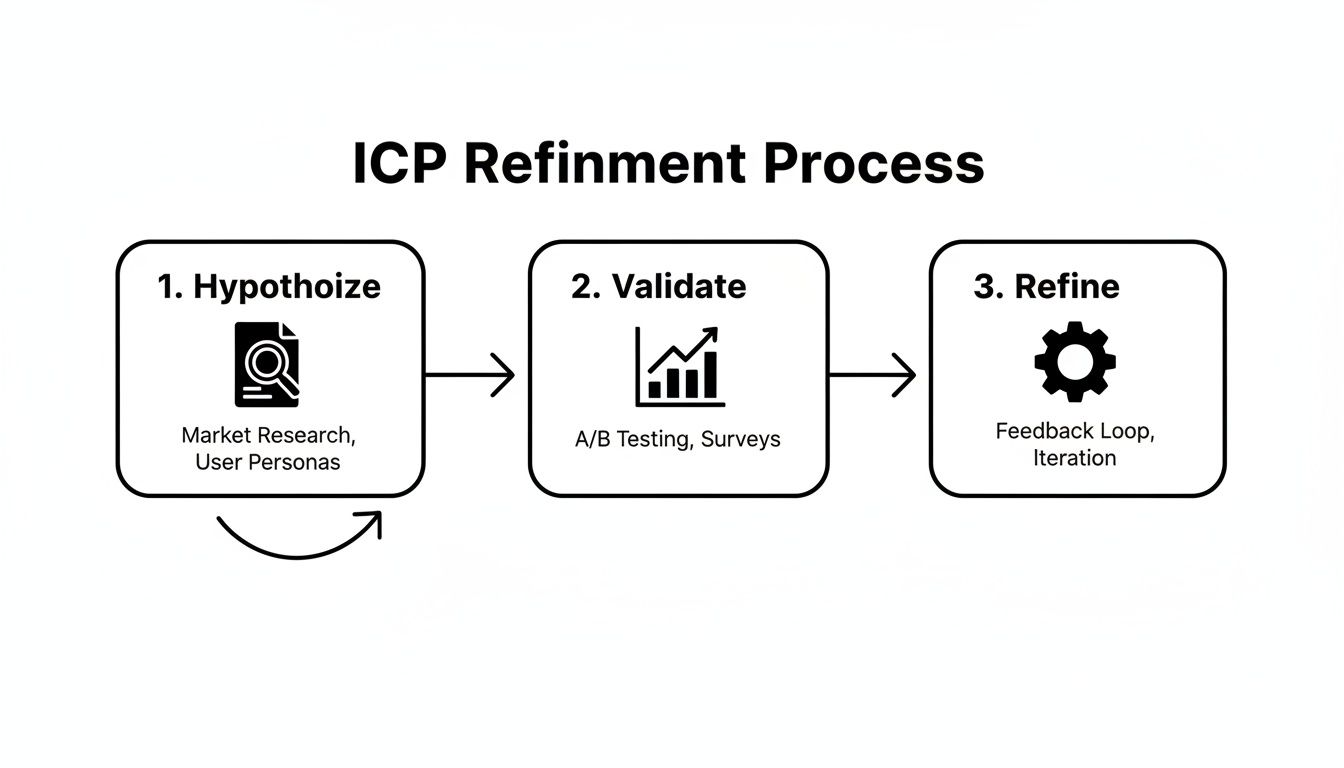
Think of it as a constant feedback loop. You start with a hypothesis, validate it with hard data, and keep refining. Your ICP is never truly "done."
Ensure Data Accuracy and CRM Integration
Building a list is one thing, but if the data is junk, so are your results. We've all been there -- an amazing list of target accounts that leads to bounced emails and disconnected phone numbers. A recent report found that 77% of organizations think their data quality is average or worse, which completely undermines their targeting efforts.
RevoScale tackles this head-on with a 97%+ data accuracy guarantee. We do this by cross-referencing information from over 50 data providers and running real-time validation checks. Your sales team can finally stop wasting cycles on bad data.
Once your data is enriched and verified, it needs to live where your team works: your CRM. RevoScale's native integrations automatically push this rich account and contact data directly into your system. This creates a single source of truth, getting your sales and marketing teams on the same page and working from the same high-quality playbook.
Activate Your ICP for Personalized Outreach
Finally, it's time for activation. With enriched lists synced to your CRM, your SDRs have everything they need to stop sending generic templates. They can craft highly personalized outreach that gets a response. For digging up even more specific details, RevoScale's AI-powered data scraper can find niche contacts and company details from across the web.
Imagine your rep reaching out and mentioning a prospect's recent tech stack addition or a key executive hire. That's how you cut through the noise.
This is what it means to operationalize an ICP. You build a list based on fit, enrich it with accurate data and timely intent signals, sync it to your CRM, and empower your sales team to engage with relevance. And with RevoScale's flat-rate, unlimited usage model, you can do all of this at scale, without worrying about the per-credit pricing that cripples teams using tools like ZoomInfo or Apollo.io.
Your ICP Template Questions, Answered
Even the most detailed guide can't cover every question. As you fill out your own ideal customer profile, you'll likely run into a few practical hurdles. Let's tackle some of the most common questions we hear from B2B teams.
How Often Should I Update My ICP Template?
Think of your ICP as a living document, not a one-and-done project. A good rhythm is to review it quarterly and plan for a more thorough overhaul once a year.
You should also revisit it anytime there's a big shift in the market or your business. The key is to constantly check it against your sales data. Are your win rates and deal velocity still highest with these accounts? If not, it's time to adjust. This keeps your targeting sharp and focused on your most profitable customers.
What Is the Biggest Mistake Companies Make When Creating an ICP?
The single biggest pitfall is building an ICP on wishful thinking instead of hard data. Too many teams describe the customers they want to have, rather than analyzing the ones they're already winning.
Always start by analyzing your best existing customers. Dig into your CRM. Who closes fastest? Who has the highest lifetime value? Who rarely churns? Your real-world successes are the blueprint for your future ones.
An ICP built on assumptions is a wish list. An ICP built on your closed-won data is a strategic asset that predicts your next best customer.
Can I Have More Than One Ideal Customer Profile?
Absolutely. In fact, it's often a smart move. You might have a core product that serves a specific industry, but a secondary feature that's perfect for a completely different segment.
It's common to have a primary ICP for your main market and secondary ICPs for other viable niches. This allows you to tailor your messaging and sales approach for each segment instead of using a one-size-fits-all strategy that doesn't connect with anyone.
How Do I Get the Data for My ICP Template?
You already have a goldmine of information in your own systems. Start by pulling reports from your CRM and billing platform. That's your foundation.
But to get the full picture -- with data points like the specific technologies a company uses (technographics) or signals that they're in-market (intent) -- you'll need a B2B data platform. This is exactly where a tool like RevoScale comes in. It enriches your existing data and fills in the gaps, giving you everything you need to build, score, and use your ICP for targeted outreach.
Ready to turn your ideal customer profile into a predictable revenue engine? RevoScale provides the unlimited, 97%+ accuracy data you need to find and engage your best-fit accounts. Stop worrying about the credit-based costs of other platforms and start focusing on results. Start your free trial today and see the difference data-driven targeting makes.